

If you’re new to Forex, the basic idea is simpler than the terminology makes it sound: you trade one currency against another, hoping the exchange rate moves in your favour.
For example, if you buy EUR/USD, you’re expecting the euro to strengthen relative to the US dollar. If the price rises and you close the trade at a higher price, you may make a profit. If it falls, you lose money.
But that’s only the starting point. To understand how forex trading works for beginners, you also need to understand currency pairs, bid and ask prices, spreads, position size, pips, leverage, margin, order execution and trading costs.
Retail Forex also doesn’t always mean physically exchanging currencies. Many online traders use derivatives such as contracts for difference (CFDs), margin contracts or rolling spot products. The exact product and legal protections depend on the provider and your jurisdiction.
 If you’re just starting out, read Forex trading for beginners
QUICK ANSWER
Forex trading works by taking a position on the exchange rate between two currencies, such as EUR/USD or NZD/USD. You buy a pair if you expect its price to rise or sell if you expect it to fall. Your profit or loss depends mainly on the size of your position and how far the exchange rate moves, while spreads, commissions, financing charges and other costs affect the final result. Retail Forex often uses leveraged derivatives, so a relatively small currency movement can have a much larger effect on your account.
How does Forex trading work?
A Forex trade can be reduced to six basic steps:
- Choose a currency pair, such as EUR/USD or NZD/USD.
- Decide whether you expect the pair to rise or fall.
- Choose your position size.
- Open the trade using an order through a trading platform.
- Monitor the position, including price movements and trading costs.
- Close the trade, with the difference between the opening and closing price contributing to your profit or loss.
The important point is that your result isn’t determined by the direction of the market alone. Position size, spread, commission, financing charges, leverage and the product you’re trading all matter.
A simple example
Suppose EUR/USD is quoted at 1.1000.
You believe the euro will strengthen against the US dollar, so you open a buy position.
Later, EUR/USD rises to 1.1050 and you close the trade.
The exchange rate has moved 50 pips in your favour. Whether that produces a large or small monetary gain depends on your position size and the costs attached to the trade.
If EUR/USD instead falls to 1.0950, the same position would produce a loss.
That’s the core mechanism: your position gains or loses value as the exchange rate changes.
What is a Forex currency pair?
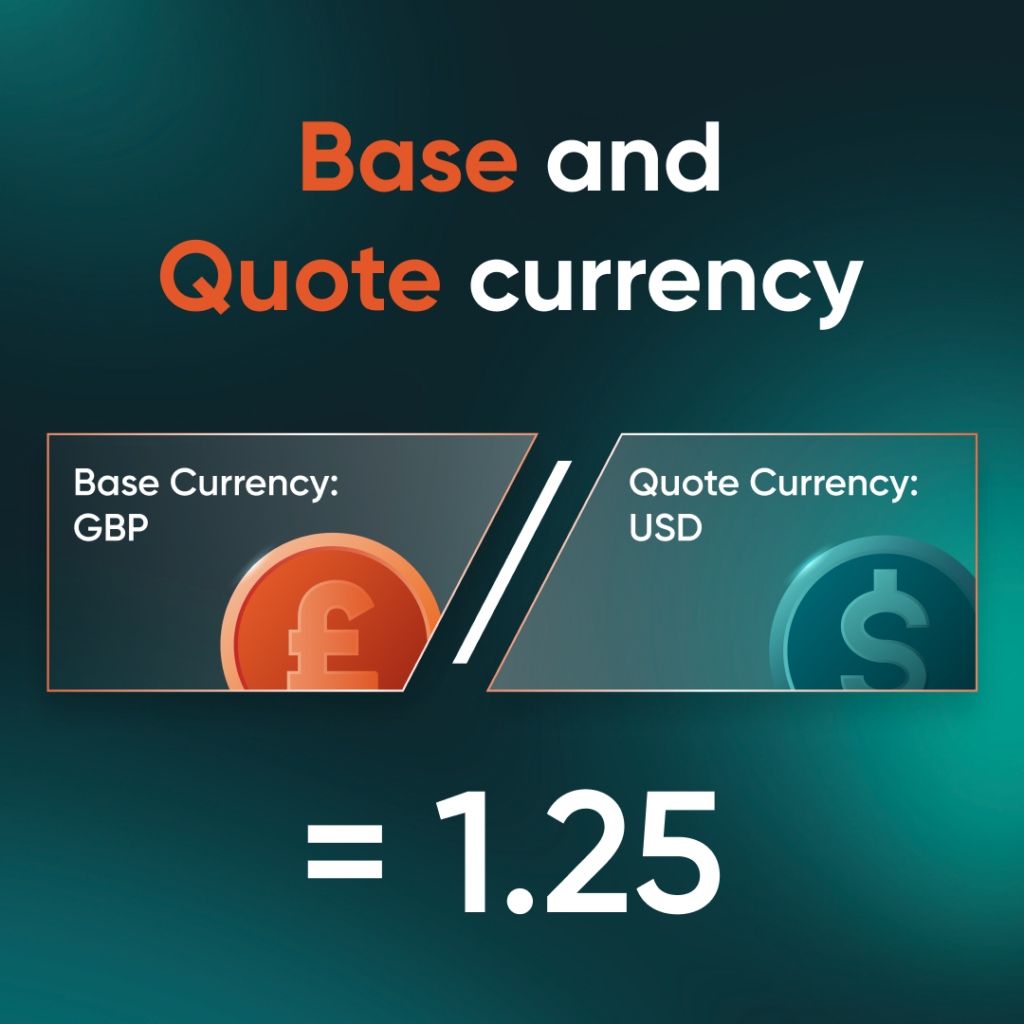
Currencies are quoted in pairs because you’re always comparing one currency with another.
Consider NZD/USD:
| Part | Meaning |
|---|---|
| NZD | Base currency |
| USD | Quote currency |
| 0.6000 | One NZD is worth US$0.60 at that quoted rate |
If NZD/USD rises from 0.6000 to 0.6100, the New Zealand dollar has strengthened relative to the US dollar.
If it falls from 0.6000 to 0.5900, the NZD has weakened relative to the USD.
This distinction matters because Forex isn’t simply about deciding whether a currency will “go up.” You’re deciding whether one currency will strengthen or weaken relative to another.
Common pairs include:
- EUR/USD
- GBP/USD
- USD/JPY
- AUD/USD
- USD/CAD
- NZD/USD
The global FX market is enormous. The Bank for International Settlements reported approximately US$9.6 trillion in average daily OTC FX turnover in April 2025, across FX instruments. That figure includes activity from banks, dealers, corporations, investment firms and other institutions, not just individual traders.
Learn the basics in our guide on what is Forex trading
What does buying or selling Forex actually mean?
This is one of the biggest beginner misunderstandings.
If you exchange NZD for USD at a bank because you’re travelling, you physically obtain another currency.
Retail Forex trading can be different. Depending on the product, you may simply have a financial contract whose value is linked to the exchange rate.
For example:
- Buy EUR/USD: you’re generally taking a position that benefits if EUR/USD rises.
- Sell EUR/USD: you’re generally taking a position that benefits if EUR/USD falls.
You don’t necessarily take delivery of euros or US dollars.
In New Zealand, the FMA’s definition of derivatives includes products such as CFDs, margin contracts and rolling spot contracts. A provider making a regulated offer of derivatives to retail investors generally needs to be licensed as a derivatives issuer under the Financial Markets Conduct framework.
This is why a beginner should ask “What product am I actually trading?” rather than assuming every Forex account works in exactly the same way.
What are bid, ask and spread?
When you look at a Forex quote, you’ll usually see two prices:
- Bid: the price at which you can sell.
- Ask: the price at which you can buy.
The difference is called the spread.
For example:
| Quote | Price |
|---|---|
| Bid | 1.1000 |
| Ask | 1.1002 |
| Spread | 0.0002 |
For a pair quoted to four decimal places, that difference is commonly described as 2 pips.
The spread is effectively one of the costs built into a trade. A position normally needs to move far enough in your favour to overcome the spread before the price movement becomes a net gain, although the exact calculation depends on the product and account.
Other possible costs include:
- commissions
- overnight or financing charges
- currency-conversion costs
- platform or account fees, depending on the provider
A common beginner mistake is to look only at the advertised spread and ignore the rest of the trading cost structure.
What is a pip?
A pip is a standard unit traders use to describe a small movement in a currency pair.
For many major currency pairs, one pip is the fourth decimal place.
For example:
EUR/USD: 1.1000 → 1.1001 = 1 pip
For many Japanese yen pairs, the conventional pip is at the second decimal place.
But a pip is a price measurement, not automatically a dollar amount.
A 20-pip movement does not necessarily mean a $20 profit or loss. The monetary value depends on factors such as:
- position size
- currency pair
- account currency
- exchange rate
- broker or product conventions
That’s why beginners should learn position size and pip value together, rather than treating “pips gained” as the same thing as money earned.
What is position size?
Position size is simply how large your trade is.
A platform might express Forex size in lots or units of currency. A standard lot is commonly associated with 100,000 units of the base currency, but retail platforms can offer much smaller sizes.
The important concept isn’t memorising the word “lot.” It’s understanding that:
The larger your position, the more money each price movement can add to or subtract from your account.
For example, two traders could both correctly predict a 30-pip rise in EUR/USD but experience very different financial results because they used different position sizes.
This is one reason beginners shouldn’t judge a trading strategy simply by looking at its percentage of winning trades.
Learn practical sizing with How to calculate Forex position size
How does leverage work in Forex?
Leverage allows you to gain exposure to a position larger than the cash amount you provide as margin.
For example, with hypothetical 10:1 leverage, $1,000 of margin could correspond to $10,000 of exposure, subject to the product and provider’s rules.
If that $10,000 exposure moves 1% against you, the change in value is $100.
The important lesson is that leverage doesn’t make the currency market itself safer or more predictable. It makes the value of your position more sensitive to price movements relative to the money you’ve deposited.
The FMA specifically highlights leverage risk for retail derivatives investors. Its consumer guidance gives an example where 1:100 leverage means a $1,000 margin could provide exposure of $100,000, so a 1% adverse move could equal $1,000.
Understand risk better with Forex leverage explained
Leverage vs position size
These concepts are related but aren’t the same.
- Position size determines how much market exposure you’re taking.
- Leverage determines how much margin is required relative to that exposure.
A beginner can therefore have access to high leverage without needing to use all of it.
The sensible question isn’t “What is the highest leverage available?” It’s “How large a position am I taking, and how much could I lose if the market moves against me?”
What is margin?
Margin is money set aside as collateral for a leveraged position.
It isn’t the same thing as a trading fee.
For example, suppose a hypothetical position has a $10,000 exposure and requires 10% margin. The required margin would be:
$10,000 × 10% = $1,000
That $1,000 doesn’t mean you’ve limited your economic exposure to $1,000. Your position is still linked to the $10,000 exposure.
If the market moves significantly against you, your available margin can fall. Depending on the provider’s rules, this can lead to a margin call or automatic closing of positions.
This is one of the mechanics beginners should understand before using leverage.
How do Forex traders make or lose money?
The basic calculation is the price difference between opening and closing, multiplied by the relevant position size, with applicable costs included.
For a simplified long trade:
Profit or loss ≈ (Closing price − Opening price) × position size
For a short trade, the direction is reversed:
Profit or loss ≈ (Opening price − Closing price) × position size
The formula is simplified because the actual calculation can involve the quote currency, account currency, exchange-rate conversion, contract specifications, spread, commissions and financing.
Example: a simplified EUR/USD trade
Imagine you buy 10,000 EUR/USD units at 1.1000 and close at 1.1050.
The price difference is:
1.1050 − 1.1000 = 0.0050
Multiply by the position size:
0.0050 × 10,000 = US$50
So the simplified gross result is US$50 before spread, commission, financing and other applicable costs.
If the pair had fallen to 1.0950 instead:
1.0950 − 1.1000 = −0.0050
−0.0050 × 10,000 = −US$50
This example is deliberately simple. Actual retail trading results can differ because of execution prices and the terms of the specific product.
Why do Forex prices move?
Currencies move because markets continually reassess the relative outlook for two economies and their currencies.
⇒ See official NZ exchange-rate data from the Reserve Bank of New Zealand FX statistics
Factors can include:
- central-bank interest-rate decisions
- inflation
- employment data
- economic growth
- government policy
- geopolitical developments
- commodity prices
- investor risk appetite
- expectations about future interest rates
For a New Zealand trader, developments affecting New Zealand, Australia, China and other major trading partners can be particularly relevant to NZD-related pairs.
The Reserve Bank of New Zealand publishes foreign-exchange data and other information useful for understanding NZD movements.
One subtle point matters here: markets react to expectations, not just headlines.
An apparently positive economic announcement doesn’t automatically mean the currency will rise. Traders may already have expected the result, or they may focus on what the announcement means for future interest rates.
⇒Learn more about Forex market size from the Bank for International Settlements FX turnover data
A Forex trade from start to finish
Here’s what the process can look like for a beginner using a retail trading platform.
1. Choose the currency pair
You might select NZD/USD, EUR/USD or another available pair.
2. Check the quote
Look at the bid, ask and spread rather than assuming the displayed chart price is exactly the price at which you can enter.
3. Decide whether to buy or sell
Your decision should be based on a defined trading approach rather than simply guessing which way the next candle will move.
4. Choose position size
This is one of the most important risk decisions.
A larger position means each pip or price movement has a larger financial effect.
5. Choose the order type
A market order generally attempts to enter at the currently available market price.
A limit order instructs the platform to enter only at a specified price or better, subject to the product’s rules and market conditions.
A stop order can be used to trigger an entry once the market reaches a specified level.
The exact behaviour and execution of orders can vary by provider.
6. Manage the open position
While the trade is open, the unrealised profit or loss changes as the market moves.
You may also have financing or other charges depending on the product and how long the position remains open.
7. Close the trade
When you close the position, the result becomes realised, subject to the applicable execution price and costs.
That completes the basic Forex trading cycle.
Common mistakes beginners make
Mistake 1: Thinking Forex is simply predicting currencies
You aren’t merely predicting whether the NZ dollar or US dollar will rise. You’re trading their relative value.
Mistake 2: Confusing leverage with profit
Leverage can increase exposure, but it doesn’t improve your ability to predict the market.
It can magnify losses just as it can magnify gains.
Mistake 3: Ignoring the spread
A trade starts with a cost. The market doesn’t need to move in your favour merely by one fraction of a pip for you to be profitable.
Mistake 4: Using position sizes that are too large
A strategy can appear reasonable on a chart but become dangerous when the position is too large for the account.
Mistake 5: Assuming a demo account proves profitability
A demo account is useful for learning order mechanics and platform features. It doesn’t prove that a strategy will make money with real capital.
Mistake 6: Choosing a provider based only on maximum leverage
A high leverage number is not a quality signal.
Beginners should investigate the provider’s regulatory status, product structure, costs, execution arrangements, client-money protections and applicable dispute-resolution mechanisms.
Improve your risk control with Forex risk management for beginners
How does Forex trading work in New Zealand?
New Zealand residents should pay particular attention to which legal entity provides the product and which regulator oversees it.
The FMA states that a derivatives issuer making a regulated offer of derivatives must be licensed. The FMA also maintains information about licensed providers and advises consumers to deal with licensed businesses where applicable.
However, “Forex trading” can cover different products, so don’t assume every foreign exchange service has the same regulatory status.
For tax, there isn’t a single simple rule that can be applied to every Forex trader. New Zealand tax treatment depends on the nature of the activity, product and individual’s circumstances. New Zealand tax residents generally have tax obligations on worldwide income, while specific financial-arrangement or foreign-investment rules can apply in some circumstances.
⇒ Understand NZ currency reporting rules via Inland Revenue foreign currency conversion guidance
If you’re a New Zealand resident, check the current information from Inland Revenue and, where appropriate, obtain professional tax advice before relying on a particular treatment.
⇒ Verify licensed providers using the FMA licensed financial market entities register
Is Forex trading suitable for beginners?
A beginner can learn how Forex trading works, but understanding the mechanics doesn’t eliminate the financial risk.
The most useful early goal is not to find a guaranteed strategy. There isn’t one.
Instead, learn to answer these questions before placing a trade:
- What currency pair am I trading?
- What product am I actually trading?
- Am I buying or selling?
- What is my position size?
- What is the spread?
- Is there a commission or financing charge?
- How much margin is required?
- How much could I lose if the market moves against me?
- Who regulates the provider?
- What happens if my available margin becomes insufficient?
If you can’t answer those questions, you probably don’t yet understand the trade well enough to risk meaningful money.
Financial-risk disclaimer
This article is for general educational purposes and isn’t personal financial, investment, legal or tax advice. Forex and leveraged derivatives can result in substantial losses, potentially including losses beyond the amount initially deposited depending on the product and provider. Regulations, product availability, leverage limits and tax treatment vary by jurisdiction and can change. Check the current rules that apply to you before trading.
⇒ Learn how tax applies to traders from the Inland Revenue tax rules for NZ residents
KEY TAKEAWAYS
- Forex always involves two currencies, so you’re trading their relative value.
- A buy position generally benefits when the currency pair rises; a sell position generally benefits when it falls.
- Position size determines how much each price movement is worth to your account.
- Leverage increases exposure and magnifies risk; it doesn’t make the market more predictable.
- Spreads, commissions and financing costs can materially affect trading results.
- Retail “Forex” can involve different products, including CFDs, margin contracts and rolling spot products.
- New Zealand traders should verify the provider’s regulatory status and check current FMA and IRD requirements.
⇒ Check how Forex derivatives are regulated via the Financial Markets Authority derivatives guidance
FAQ’s
Can I make money trading Forex?
Yes, it is possible to make a profit on individual Forex trades, but losses are also possible and there is no reliable system that guarantees profits. Leverage can make both gains and losses larger relative to the capital committed.
How much money do I need to start Forex trading?
There is no universal minimum that applies to every provider or product. Some accounts permit small position sizes, but the minimum deposit isn’t the most useful measure of affordability. A better question is how much you could afford to lose and whether the position size is appropriate for your risk tolerance.
Is Forex trading the same as exchanging money at a bank?
No. Exchanging money for travel usually involves obtaining another currency. Retail Forex trading often involves a derivative whose value is linked to an exchange rate rather than physical delivery of the currencies.
What is the easiest Forex pair for a beginner?
There isn’t a universally “easiest” pair. Beginners often study highly traded major pairs because their mechanics and market information are widely covered, but every currency pair carries risk and can behave differently under changing market conditions.
Can I trade Forex from New Zealand?
New Zealand residents can access Forex-related products, but the regulatory treatment depends on the product and provider. A derivatives issuer making a regulated offer of derivatives to retail investors in New Zealand generally needs the appropriate FMA licence.
Does Forex trade 24 hours a day?
The global foreign-exchange market operates across international financial centres during the business week, but the exact trading availability, daily breaks and holiday schedule can vary by currency pair, broker and product.
What happens if a Forex trade moves against me?
Your open position develops an unrealised loss. If the loss reduces your available margin sufficiently, your provider may require additional funds or close positions according to its margin rules. The exact process depends on the product and provider.
Is Forex trading gambling?
Trading and gambling aren’t identical concepts, but a Forex trade can become highly speculative if it is based on random guesses rather than a defined method and risk controls. Unlike a conventional casino game, Forex prices are influenced by economic, financial and geopolitical information, but that doesn’t make outcomes predictable.