

Forex Trading for Beginners: A Practical Step-by-Step Guide
If you’re completely new to forex, you don’t need to learn a complicated trading strategy on day one. You first need to understand what you’re trading, how a trade makes or loses money, what it costs, and how much you could lose before you place it.
Forex trading is the buying and selling of currencies, usually quoted as pairs such as EUR/USD, GBP/USD or NZD/USD. Retail traders often access the market through leveraged products, which means a relatively small amount of account capital can control a larger position. That can increase potential gains, but it can also make losses happen much faster.
The sensible way to approach forex trading for beginners is therefore to learn the mechanics first, practise without meaningful financial risk, develop a basic trading plan, and only then consider whether live trading is appropriate for you.
This guide walks through that process step by step.
Risk warning: Forex trading can result in substantial losses. Leverage can magnify both gains and losses. This article is general educational information, not personalised financial, investment, legal or tax advice.
QUICK ANSWER
Forex trading for beginners means learning how to buy and sell currency pairs while understanding the costs and risks involved. A sensible step-by-step approach is to learn currency pairs and pips, understand spreads and position size, learn how leverage and margin work, choose a properly regulated provider, practise with a demo account, create a simple risk-management plan, and only then consider live trading. Forex is highly risky, and leverage can magnify losses as well as gains.
What Is Forex Trading?
Forex, short for foreign exchange, is the market where one currency is exchanged for another.
A forex quote is normally displayed as a currency pair:
| Pair | What it compares |
|---|---|
| EUR/USD | Euro against US dollar |
| GBP/USD | British pound against US dollar |
| USD/JPY | US dollar against Japanese yen |
| AUD/USD | Australian dollar against US dollar |
| NZD/USD | New Zealand dollar against US dollar |
Suppose NZD/USD is quoted at 0.6000.
That means one New Zealand dollar is represented by 0.60 US dollars at that quoted exchange rate.
If you buy NZD/USD, you’re generally taking the view that the New Zealand dollar will strengthen relative to the US dollar. If you sell the pair, you’re generally taking the opposite view.
The key word is relative.
A currency doesn’t simply become “strong” or “weak” in isolation. Its value is measured against another currency. That’s why understanding currency pairs is the first major building block for a beginner.
 Before getting into the practical steps, you can first learn what forex trading is and how the market works.
The global FX market is enormous. The Bank for International Settlements reported average over-the-counter foreign-exchange turnover of approximately US$9.6 trillion per day in April 2025 across all FX instruments. That figure includes activity from banks, financial institutions, corporations and other market participants; it should not be interpreted as the amount available for an individual retail trader.
⇒ Source: The global foreign-exchange market is exceptionally large, with average OTC FX turnover reaching about US$9.6 trillion per day in April 2025, according to the BIS.
How Does Forex Trading Work?
At its simplest, a forex trade has five decisions:
- Choose a currency pair.
- Decide whether you expect the pair to rise or fall.
- Choose how much to trade.
- Decide where the trade becomes invalid or too risky.
- Close the trade and assess the result.
Imagine EUR/USD is trading at 1.1000.
You believe the euro will strengthen against the US dollar, so you open a buy position.
Later, EUR/USD reaches 1.1050 and you close the position.
The market has moved 50 pips in your favour. Whether that translates into a small or large monetary gain depends on your position size, the product you’re trading, your account currency and trading costs.
If EUR/USD falls instead, the same buy position loses value.
That’s the basic mechanism. The difficult part isn’t clicking “Buy” or “Sell.” The difficult part is deciding when to trade, how much to risk and how to respond when the market doesn’t behave as expected.
The Forex Terms You Need Before Your First Trade
A beginner can easily become overwhelmed by forex terminology. Fortunately, you don’t need to memorise hundreds of terms.
Start with these.
| Term | Simple meaning | Why it matters |
|---|---|---|
| Currency pair | Two currencies quoted against each other | Defines the market you’re trading |
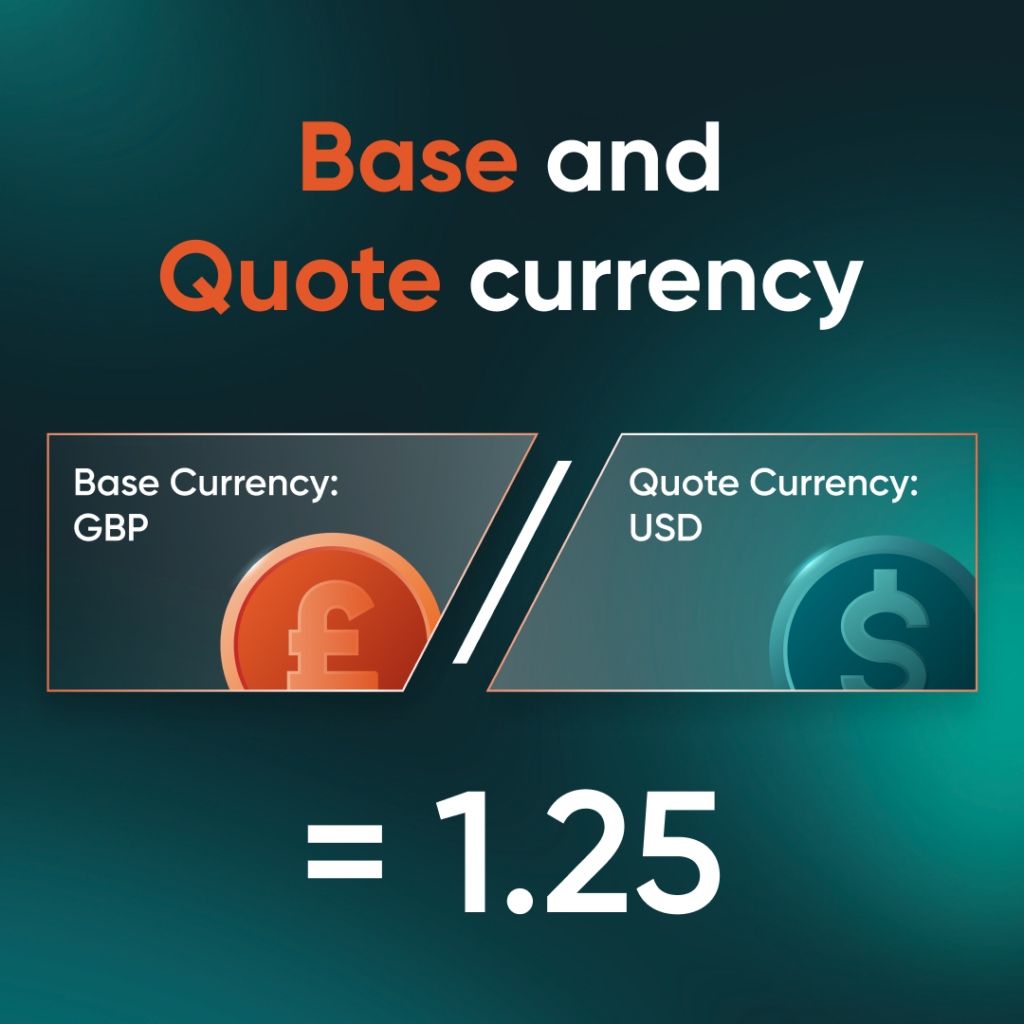
| Base currency | First currency in a pair | Shows what you’re buying or selling relative to the quote currency |
| Quote currency | Second currency in a pair | Expresses the price of the base currency |
| Pip | A standard unit of small price movement | Helps describe gains and losses |
| Spread | Difference between buy and sell prices | One of the costs of trading |
| Position size | Amount of currency or exposure traded | Determines how much each price movement is worth |
| Leverage | Allows greater market exposure relative to deposited margin | Can magnify gains and losses |
| Margin | Capital required to maintain a leveraged position | Determines how much account capital is committed |
| Stop-loss | An order intended to close a position at a specified level | Can help control planned downside, though execution isn’t guaranteed in all conditions |
| Take-profit | An order intended to close a position at a specified target | Can automate an exit |
| Volatility | How much and how quickly prices move | Affects trading risk |
Pips
A pip is a conventional unit for describing a small movement in a currency pair.
For many major currency pairs, one pip is the fourth decimal place. For example:
1.1000 → 1.1001 = 1 pip
Japanese yen pairs commonly use the second decimal place as the standard pip position.
Pip value depends on the currency pair, position size and account currency. A 20-pip movement is therefore not automatically a $20 profit or loss.
Before calculating trade size, make sure you understand what a forex pip is and how pip movements translate into potential gains or losses.
Spread
The spread is the difference between the price at which you can buy and the price at which you can sell.
For example:
- Buy price: 1.1002
- Sell price: 1.1000
- Spread: 2 pips
The spread is one reason a newly opened trade can show a small loss immediately.
Don’t judge a broker by a headline spread alone. Consider how spreads behave under different market conditions, along with commissions, financing charges and other costs.
Remember that every trade has a cost, so beginners should understand what a forex spread is before comparing trading conditions.
Position Size
Position size is one of the most important concepts for a beginner because it connects the market movement to your actual financial exposure.
Suppose two traders both buy EUR/USD and the pair falls by 30 pips.
The trader with a small position may experience a relatively small loss. The trader with a much larger position can lose many times more from exactly the same market movement.
This is why “How much leverage does the broker offer?” is usually a less useful beginner question than:
“How large is my position relative to my account, and how much could I lose?”
Step-by-Step: Forex Trading for Beginners
The following process is deliberately slower than the way forex is often marketed online.
That’s a feature, not a flaw.
Step 1: Learn How a Currency Pair Moves
Pick one or two liquid, widely followed pairs rather than watching dozens of markets.
For example, a New Zealand beginner might start by observing:
NZD/USD
A global beginner might choose:
EUR/USD
Learn to answer three questions:
- What does the pair represent?
- What would cause the pair to rise or fall?
- How much does a given price movement mean for your planned position?
Don’t worry about predicting every movement.
Your first objective is simply to understand the relationship between the two currencies.
Step 2: Understand What Actually Moves Prices
Currency prices respond to changing expectations about economies, interest rates and financial conditions.
Common influences include:
- Central-bank interest-rate decisions
- Inflation
- Employment data
- Economic growth
- Government policy
- Political and geopolitical developments
- Commodity prices
- Investor risk appetite
- Expectations about future interest rates
For example, if markets begin expecting a central bank to keep interest rates higher than previously thought, its currency may strengthen. But there is no universal rule that “higher rates always mean a stronger currency.”
Markets react to expectations and surprises, not just the headline number.
A piece of economic news can therefore produce an unexpected price reaction if traders had already anticipated it.
To understand why currency pairs move, learn more about what moves currency prices before relying on individual indicators or trading signals.
For NZD traders, developments affecting New Zealand and its major trading partners can be particularly relevant. The Reserve Bank of New Zealand publishes exchange-rate information and monetary-policy material that can help beginners distinguish primary information from trading commentary.
Step 3: Learn the Difference Between Spot FX and Leveraged Products
“Forex trading” doesn’t always describe exactly the same financial product.
A person exchanging NZD for USD before travelling is performing a foreign-currency transaction.
A retail trader using a broker to speculate on EUR/USD may instead be trading a derivative linked to the exchange rate, such as a CFD, margin FX product or another contract.
That distinction matters because the product determines things such as:
- How the trade is settled
- Whether you take ownership of currency
- How leverage works
- What fees apply
- What regulatory protections may apply
- What happens if the provider becomes insolvent
In New Zealand, the FMA treats a number of exchange-rate-linked products, including CFDs, margin contracts and rolling spot contracts, as derivatives under the relevant framework. A derivatives issuer making a regulated offer of derivatives must be licensed by the FMA.
Never assume that every website offering “forex” gives you the same product or the same protections.
Step 4: Choose a Broker by Regulation, Product and Cost
A broker is not just an app for placing trades. It’s the company or provider through which you access the trading product.
For beginners, a sensible broker checklist includes:
- Which legal entity will hold your account?
- Which regulator oversees that entity?
- What exact forex product are you trading?
- What are the spreads?
- Are commissions charged?
- Are there overnight financing or swap charges?
- What are the minimum position sizes?
- How are client funds handled?
- What happens during extreme market conditions?
- What dispute-resolution arrangements apply?
- What leverage is available?
- What educational and risk-management tools are provided?
Don’t choose a broker simply because it advertises the highest leverage.
For New Zealand residents, the FMA specifically advises consumers to check that providers are appropriately licensed. The FMA maintains information about licensed providers, while the Financial Service Providers Register can provide additional registration information.
The FMA also warns that overseas providers may not give New Zealand consumers the same regulatory protections as a New Zealand-licensed provider.
Step 5: Open a Demo Account
A demo account lets you practise placing trades without immediately risking real money.
Use it to learn:
- How market and limit orders work
- How spreads appear
- How position size changes your exposure
- How stop-loss and take-profit orders work
- How your trading platform displays profit and loss
- How to monitor open positions
- How to keep a trading journal
But don’t make the common mistake of treating a profitable demo account as proof that you’ve found a profitable system.
Real trading introduces financial and psychological pressure that a demo environment cannot fully reproduce.
The purpose of demo trading is skill development, not confirmation that you can reliably predict markets.
Step 6: Learn Leverage Before You Use It
Leverage allows you to obtain greater market exposure relative to the amount of capital deposited as margin.
Consider a simplified example.
Suppose you have $1,000 and use 10:1 leverage.
Your maximum theoretical exposure could be $10,000, depending on the product and provider.
If that $10,000 exposure moves 1% against you, the change in value is approximately:
$10,000 × 1% = $100
That represents a $100 change before considering spread, commission, financing and other costs.
The important point is that leverage hasn’t made the currency market itself less volatile. It has increased the sensitivity of your account to the market movement.
The FMA has highlighted high leverage as a significant risk for retail derivatives investors. Its 2024 consultation proposed leverage limits for retail derivatives, but that consultation should not be confused with a blanket statement that those proposed limits are currently applicable to every New Zealand forex product. Product and provider conditions need to be checked individually.
⇒ Source: The FMA has also consulted on proposed changes affecting retail derivatives, so traders should distinguish proposed rules from requirements currently in force.
Step 7: Decide Your Maximum Loss Before Entering
This is where beginner forex education should move from theory to risk management.
Before opening a trade, know:
- Entry price
- Position size
- Planned stop-loss level, if appropriate
- Approximate monetary loss if the stop is reached
- Trading costs
- What would make you abandon the original trade idea
A stop-loss can help automate an exit, but it isn’t a guarantee of the exact loss you will experience. During extreme market movements, prices can move rapidly or liquidity can change, affecting execution.
The FMA specifically cautions that stop-loss orders may not protect traders from losses in all extreme market conditions.
Step 8: Understand Risk Per Trade
There is no universal percentage of account capital that every trader should risk.
What matters is that you establish a loss limit that is consistent with your circumstances and that you understand the consequences of a series of losing trades.
For example, suppose a hypothetical trader has a $5,000 account and decides, purely for illustration, that a particular trade should have a maximum planned loss of $50.
The trader then needs to select a position size that makes the distance between the entry and planned stop consistent with that $50 risk.
The calculation is conceptually:
Position size = Maximum planned loss ÷ (stop distance × value per unit of movement)
The exact calculation depends on the currency pair, account currency, contract specification and broker conventions.
This is a much more useful way to think about trade size than saying:
“I have $5,000, so I should trade a $5,000 position.”
Your account balance and your position size are related, but they are not the same thing.
Step 9: Build a Simple Trading Plan
A trading plan doesn’t need to be a 50-page document.
A beginner plan might specify:
- Which currency pairs you trade
- Which timeframes you use
- What conditions must exist before entering
- Where the trade idea becomes invalid
- How position size is calculated
- Which market events you avoid trading around
- When you will stop trading for the day
- How you record results
The purpose isn’t to predict the market perfectly.
It’s to prevent every decision from being made emotionally in the middle of a fast-moving market.
Step 10: Keep a Trading Journal
A journal can reveal problems that individual trades hide.
Record:
- Date and time
- Currency pair
- Buy or sell
- Entry price
- Exit price
- Position size
- Planned stop
- Actual result
- Trading costs
- Reason for entering
- Reason for exiting
- Whether you followed your plan
- What you would change next time
After 20 or 30 trades, the journal may tell you more about your behaviour than another hour spent watching trading videos.
For example, you might discover that your strategy isn’t necessarily the biggest problem. You may simply be entering too many trades after losses, trading outside your preferred hours or increasing position size after a winning streak.
A Simple Beginner Trade Example
Consider a hypothetical NZD/USD trade.
The pair is quoted at:
NZD/USD = 0.6000
You believe the New Zealand dollar may strengthen against the US dollar.
You therefore consider a buy position.
Before entering, you establish:
- Entry: 0.6000
- Planned exit if the idea fails: 0.5960
- Target: 0.6080
- Position size: deliberately kept small
- Maximum planned loss: an amount you can afford within your trading plan
If the market reaches 0.6080, the price has moved 80 pips in your favour.
If it reaches 0.5960, it has moved 40 pips against you.
Notice what hasn’t been assumed:
We haven’t said that the trade will win.
We haven’t said that 80 pips equals a particular dollar profit.
And we haven’t suggested that the 2:1 relationship between the illustrative target and stop makes the trade profitable.
The market can move against the position immediately.
The point of the example is to show how a trader can define the trade before the outcome is known.
What Beginners Often Get Wrong
Mistake 1: Starting With Leverage
A high leverage setting can make a small account look capable of controlling a surprisingly large position.
That doesn’t mean the position is sensible.
Start with position size and risk. Treat leverage as a tool that affects those calculations, not as a target to maximise.
Mistake 2: Believing More Trades Mean More Opportunity
More trades also mean more opportunities to make mistakes and pay trading costs.
A beginner who watches five currency pairs and trades every small movement can quickly lose track of the original reason for entering.
Focus can be more useful than constant activity.
Mistake 3: Ignoring the Spread and Other Costs
A strategy can look attractive before costs and much less attractive after them.
Consider:
- Spread
- Commission
- Overnight financing
- Currency conversion
- Slippage
- Other broker charges
The relevant costs depend on the product and provider.
Mistake 4: Treating Economic News as a Simple Buy/Sell Signal
“Inflation was higher, so the currency must fall” sounds straightforward.
Markets aren’t.
The actual result depends on what investors expected, what was already priced into the market, how the central bank may respond and how other economies are developing.
Mistake 5: Increasing Size After a Loss
A losing trade can create an emotional urge to recover the money quickly.
Increasing position size to “make it back” can turn one manageable loss into a much larger problem.
Mistake 6: Assuming a Demo Strategy Will Work Live
A demo account removes much of the financial pressure of real trading.
A strategy that looks easy with imaginary money can feel very different when every price movement affects your actual savings.
Mistake 7: Following Signals Without Understanding Them
A signal can tell you what someone else thinks.
It doesn’t necessarily explain:
- Why the trade exists
- What invalidates it
- How much risk is appropriate
- Whether the product suits you
- What happens if the market moves rapidly
Learning the reasoning behind a trade is more valuable than collecting alerts.
How to Choose Your First Currency Pair
There isn’t one universally “best” forex pair for every beginner.
A sensible starting point is to choose a pair that has:
- Plenty of market information available
- Clear economic drivers you can learn about
- Trading costs you understand
- A trading schedule you can realistically monitor
Major pairs such as EUR/USD and USD/JPY are widely followed.
For New Zealand readers, NZD/USD is also a natural pair to study because it directly involves the New Zealand dollar.
You don’t need to trade every pair you study.
In fact, beginners can learn a great deal by following one or two pairs consistently and observing how they respond to economic events.
If you’re deciding which markets to study first, explore major forex pairs and learn why they are commonly followed by traders.
When Does the Forex Market Trade?
Forex is a global over-the-counter market spread across international financial centres, so trading activity continues through much of the working week as different markets open and close.
However, “24 hours” doesn’t mean every currency pair or broker is available continuously without interruptions.
Your broker may have:
- Daily maintenance periods
- Different opening and closing times
- Weekend closures
- Different liquidity conditions
- Product-specific trading schedules
New Zealand traders also need to account for daylight-saving changes when comparing local time with major international trading sessions.
Instead of memorising a generic timetable, check the trading schedule supplied by your broker for the exact product you’re using.
The site’s forex market hours guide can help explain the major sessions and their overlaps.
Forex Trading in New Zealand
New Zealand readers should pay particular attention to the regulatory status of the provider and the exact product being offered.
The Financial Markets Authority states that a derivatives issuer making a regulated offer of derivatives to retail investors must be licensed. Its definition of derivatives includes various products linked to exchange rates, including contracts for difference and margin contracts.
The FMA also warns that forex trading for profit is very risky and recommends that New Zealand consumers check they are using an appropriately licensed provider.
⇒ Source: In New Zealand, firms making regulated offers of derivatives to retail investors generally need to meet the FMA’s licensing requirements for derivatives issuers.
Before depositing money, check:
- The legal name of the provider.
- Which entity your account is actually with.
- The relevant licence or regulatory status.
- The exact financial product.
- The product disclosure statement and terms.
- How client money is handled.
- Fees, leverage and margin requirements.
- Dispute-resolution arrangements.
A provider having a foreign licence doesn’t automatically mean it has the same regulatory status or protections in New Zealand.
⇒ Source: For New Zealand traders, the FMA provides guidance on the risks of forex trading and recommends checking that a provider is appropriately licensed.
What About Forex Tax in New Zealand?
There isn’t a single simple tax rule that can be applied to every person who calls themselves a forex trader.
Tax treatment can depend on the financial product, the nature of the activity, how transactions are structured and your individual circumstances.
Inland Revenue’s current guidance explains that New Zealand’s financial-arrangements rules can apply to certain financial arrangements and that specific methods may be required for calculating income and expenditure. It also provides rules for converting foreign-currency amounts into NZ dollars for tax purposes.
⇒ Source: When foreign-currency amounts need to be reported in New Zealand dollars, Inland Revenue’s currency-conversion guidance explains the applicable conversion methods.
That means beginners shouldn’t assume that:
- every forex gain is taxed identically;
- every loss is automatically deductible;
- a foreign broker changes your New Zealand tax obligations; or
- simply withdrawing money into a NZ bank account determines when tax applies.
Keep detailed records of trades, fees, deposits, withdrawals and currency conversions.
If you are a New Zealand tax resident and your trading activity is material or complicated, check current Inland Revenue guidance and consider obtaining advice from a qualified tax professional.
⇒ Source: New Zealand tax treatment can depend on the nature of the financial arrangement, so traders should consult Inland Revenue’s current financial-arrangements guidance rather than assume all forex gains and losses are treated alike.
How Much Money Do You Need to Start Forex Trading?
There is no single amount that makes sense for everyone.
Different brokers and products have different minimum deposits and position sizes. More importantly, the amount you can technically deposit is not the same as the amount you can safely afford to lose.
A better beginner question is:
“How much could I lose without affecting my essential financial commitments?”
If the answer is “not much,” that is a reason to keep learning and practising rather than a reason to use more leverage.
You don’t need a large account to learn how forex works.
Is Forex Trading Suitable for Beginners?
Learning about forex is absolutely possible for a beginner.
That doesn’t mean leveraged forex trading is appropriate for every beginner.
There’s a useful distinction:
Learning forex:
Understanding currency pairs, economic drivers, orders, costs and risk while keeping financial exposure low.
Trading forex with real money:
Accepting the possibility of losses and making decisions about position size, leverage, product choice and risk.
The FMA describes forex trading for profit as very risky and has repeatedly highlighted the risks associated with leveraged derivatives.
If you still aren’t comfortable explaining a pip, spread, margin, leverage and position size in your own words, there’s little reason to rush into a large live position.
A Beginner Forex Checklist
Before placing your first live trade, you should be able to answer “yes” to most of these:
- I understand what my currency pair represents.
- I know which currency is the base currency.
- I understand what a pip means.
- I know how the spread affects my trade.
- I know my position size.
- I understand how leverage affects my exposure.
- I know how much I could lose if the market moves against me.
- I understand the product I’m actually trading.
- I’ve checked my provider’s regulatory status.
- I’ve read the relevant product information.
- I’ve practised placing and closing trades.
- I have a basic entry and exit plan.
- I keep records of my trades.
- I’m not using money needed for rent, bills or essential expenses.
- I’m not relying on forex trading as guaranteed income.
If several answers are “no,” that’s useful information. It tells you what to learn next.
The Best Way to Think About Forex as a Beginner
The biggest mindset change is simple:
Your first goal isn’t to make money. Your first goal is to understand risk.
A beginner who knows exactly how a trade can lose $100 is in a much stronger position than someone who knows ten technical indicators but hasn’t calculated the downside.
Forex rewards preparation only in the sense that preparation can improve decision-making. It doesn’t remove uncertainty.
No indicator, signal provider, trading robot or strategy can reliably predict every currency movement.
A sensible learning sequence is:
Understand the market → learn the vocabulary → study one or two pairs → practise → understand risk → build a plan → review your results → decide whether live trading is appropriate.
That sequence may feel slower than jumping straight into a highly leveraged account.
For a beginner, slower is often the more useful approach.
Conclusion
Forex trading for beginners becomes much easier to understand when you stop treating it as a hunt for a perfect strategy and start treating it as a process of making controlled decisions under uncertainty.
Learn how currency pairs work. Understand pips, spreads and position size. Know exactly what product your broker offers. Treat leverage with caution. Decide how much you could lose before entering a trade. Practise on a demo account and keep a trading journal.
For New Zealand traders, add one more step: verify the provider’s regulatory status and understand the NZ tax and regulatory framework that applies to your particular circumstances.
The next useful step isn’t necessarily finding another trading strategy. It’s learning how the individual building blocks fit together, particularly currency pairs, pips, spreads, market hours and the forces that move exchange rates.
KEY TAKEAWAYS
- Forex always involves a relationship between two currencies, not one currency in isolation.
- Position size is often more important to beginner risk than the maximum leverage advertised by a broker.
- Spreads, commissions, financing and other costs can materially affect trading results.
- Demo trading is useful for learning mechanics, but it doesn’t prove that a strategy will be profitable with real money.
- New Zealand traders should verify the provider’s regulatory status and the exact forex product being offered.
- NZ tax treatment can depend on the nature of the financial arrangement and the individual’s circumstances.
- The first useful beginner objective is understanding potential losses before chasing potential profits.
FAQ’s
1. Is forex trading good for beginners?
Learning forex can be suitable for beginners, but leveraged live trading is not automatically suitable for everyone. Beginners should understand the product, costs, leverage and potential losses before risking meaningful money.
2. How do I start forex trading step by step?
Start by learning currency pairs, pips and spreads. Then study one or two pairs, learn position sizing and leverage, choose a suitable and appropriately regulated provider, practise on a demo account, develop a trading and risk plan, and only consider live trading once you understand the potential downside.
3. How much money do I need to start forex trading?
There is no universal minimum. Brokers and products have different requirements. For a beginner, the more useful question is how much money can be lost without affecting essential expenses. You should not trade money you cannot afford to lose.
4. Can I make money trading forex?
Profitable trades are possible, but losses are also possible and no strategy guarantees profits. Leverage, volatility and trading costs can significantly affect results.
5. What is the easiest forex pair for beginners?
There is no universally easiest pair. EUR/USD and USD/JPY are widely followed, while NZD/USD may be especially relevant to New Zealand readers. Beginners can benefit from studying a small number of markets rather than constantly switching pairs.
6. Is forex trading legal in New Zealand?
Foreign-exchange activity can take different forms, so the regulatory treatment depends on the product and provider. The FMA states that derivatives issuers making regulated offers of derivatives to retail investors in New Zealand must be licensed.
7. Is forex trading taxed in New Zealand?
Tax treatment depends on the circumstances and the type of financial arrangement involved. Inland Revenue provides specific guidance on financial arrangements and foreign-currency conversion, so traders should not assume that every forex gain or loss receives identical tax treatment.
8. Is forex trading the same as exchanging money for travel?
No. Exchanging NZD for USD before a holiday is a currency transaction, while retail forex speculation may involve a derivative linked to an exchange rate. The product, risks and regulatory treatment can therefore be different.