
If you’re new to Forex, the terminology can make trading look more complicated than it is. Words such as pip, spread, leverage, margin, lot, bid, ask, and stop-loss appear almost immediately, and misunderstanding one of them can lead to a very different picture of what a trade actually involves.
The good news is that most Forex trading terms describe fairly simple ideas.
This glossary explains 50 forex trading terms beginners need to know, using plain-English definitions and practical examples. You don’t need to memorise everything before learning to trade. Use it as a reference and focus first on the terms that affect how much you can gain or lose.
Risk reminder: Forex trading, particularly leveraged Forex or CFD trading, can result in substantial losses. The examples below are educational illustrations, not trading recommendations or guarantees.
 If you’re completely new to the market, start with our guide to what is Forex trading before working through the terminology below.
QUICK ANSWER
Forex trading terms are the words traders use to describe currency pairs, prices, trade size, costs, orders, leverage, margin and risk. The most important terms for a beginner to understand are currency pair, base currency, quote currency, pip, pip value, spread, bid, ask, lot, position size, leverage, margin, equity, stop-loss and take-profit.
The key relationship is simple: position size determines your market exposure; pip movements affect the position’s value; spread and other costs affect the result; leverage reduces the capital required for a given exposure but can magnify losses; and margin supports the leveraged position.
The 50 Forex terms at a glance
| # | Term | Simple meaning |
|---|---|---|
| 1. | Forex |
|
| 2. | Currency pair |
|
| 3. | Base currency |
|
| 4. | Quote currency |
|
| 5. | Exchange rate |
|
| 6. | Major pair |
|
| 7. | Minor pair |
|
| 8. | Exotic pair |
|
| 9. | Pip |
|
| 10. | Pipette |
|
| 11. | Pip value |
|
| 12. | Spread |
|
| 13. | Bid price |
|
| 14. | Ask price |
|
| 15. | Lot |
|
| 16. | Position |
|
| 17. | Long |
|
| 18. | Short |
|
| 19. | Leverage |
|
| 20. | Margin |
|
| 21. | Free margin |
|
| 22. | Margin call |
|
| 23. | Stop-out |
|
| 24. | Equity |
|
| 25. | Balance |
|
| 26. | Drawdown |
|
| 27. | Volatility |
|
| 28. | Liquidity |
|
| 29. | Slippage |
|
| 30. | Market order |
|
| 31. | Limit order |
|
| 32. | Stop order |
|
| 33. | Stop-loss |
|
| 34. | Take-profit |
|
| 35. | Pending order |
|
| 36. | Risk-reward ratio |
|
| 37. | Position size |
|
| 38. | Trading session |
|
| 39. | Market hours |
|
| 40. | Economic calendar |
|
| 41. | Central bank |
|
| 42. | Interest rate |
|
| 43. | Monetary policy |
|
| 44. | Fundamental analysis |
|
| 45. | Technical analysis |
|
| 46. | Support |
|
| 47. | Resistance |
|
| 48. | Swap / rollover |
|
| 49. | Broker |
|
| 50. | Trading platform |
|
1. Forex
Forex, short for foreign exchange, is the market where currencies are exchanged.
⇒ Source: For New Zealand market context, the Reserve Bank of New Zealand publishes foreign exchange turnover statistics covering activity in the NZ foreign-exchange market.
A Forex quote such as EUR/USD represents the value of the euro relative to the US dollar.
Forex is a global, decentralised over-the-counter market rather than a single exchange. The Bank for International Settlements’ 2025 survey continues to document the enormous scale of global foreign-exchange activity.
⇒ Source: The scale of the global currency market is documented in the BIS Triennial Central Bank Survey of foreign exchange and OTC derivatives markets.
Beginner takeaway: Forex is about currencies being exchanged in pairs, not about buying a single currency in isolation.
2. Currency pair
A currency pair compares one currency with another.
For example, in EUR/USD, EUR is the first currency and USD is the second.
If EUR/USD is quoted at 1.1000, the simplified interpretation is that one euro is worth 1.10 US dollars.
Before moving on, make sure you understand what is a currency pair, because every Forex quote compares one currency with another.
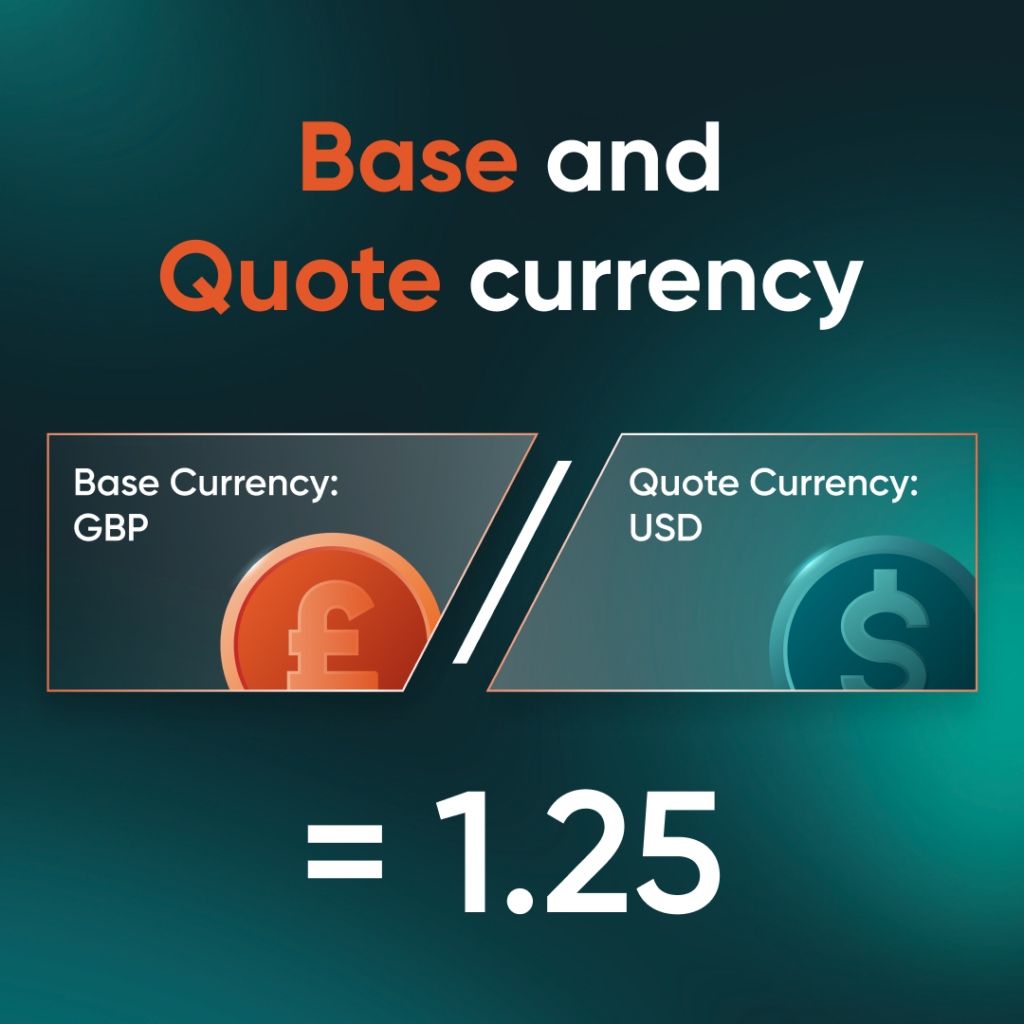
3. Base currency
The base currency is the first currency in a pair.
In GBP/USD, GBP is the base currency.
When you buy GBP/USD, you’re buying the base currency and selling the quote currency at the same time.
4. Quote currency
The quote currency is the second currency.
In USD/JPY, USD is the base currency and JPY is the quote currency.
The quote tells you how many units of the quote currency are needed to value one unit of the base currency.
5. Exchange rate
An exchange rate tells you the value of one currency relative to another.
For example, if NZD/USD is 0.6000, the quote expresses the value of one New Zealand dollar in US dollars.
Exchange rates change continuously as market conditions change.
6. Major pair
A major currency pair generally refers to one of the heavily traded currency pairs involving the US dollar, such as EUR/USD, GBP/USD, USD/JPY, USD/CHF, AUD/USD, USD/CAD and NZD/USD.
Major pairs tend to attract substantial market activity, but “major” doesn’t mean risk-free.
If you want to explore the most widely traded currency combinations, our guide to major Forex pairs is the natural next step.
7. Minor pair
A minor pair, sometimes called a cross, is a currency pair that doesn’t include USD.
Examples include EUR/GBP, EUR/AUD and GBP/JPY.
You can also learn more about currency crosses in our guide to minor Forex pairs.
8. Exotic pair
An exotic pair typically combines a major currency with the currency of a smaller or emerging economy, such as USD/TRY.
Exotic pairs can have wider spreads and different liquidity characteristics. A beginner shouldn’t assume that a lower-priced currency automatically makes an exotic pair cheaper or safer to trade.
9. Pip
A pip is a commonly used unit for measuring small changes in a Forex exchange rate.
For many currency pairs, a pip is the fourth decimal place. For pairs involving the Japanese yen, a pip is commonly the second decimal place.
For example, EUR/USD moving from 1.1000 to 1.1010 represents a 10-pip movement.
The exact convention can vary, so check your broker’s specifications.
If pips are still confusing, our guide explains what is a Forex pip in more detail, including how pip movements relate to trade value.
10. Pipette
A pipette is a fractional pip.
A broker quoting EUR/USD to five decimal places might display 1.10005 rather than 1.1000.
That extra decimal can allow more precise pricing, but beginners shouldn’t confuse a pipette with a full pip.
11. Pip value
Pip value is the amount of money represented by a one-pip price movement for a particular position.
It depends on factors including:
- Position size
- Currency pair
- Account currency
- Exchange rate
- Broker conventions
This is why saying “one pip always equals $10” is misleading. That figure can apply to particular standard-lot circumstances, but it isn’t universal.
12. Spread
The spread is the difference between the bid price and ask price.
Suppose EUR/USD is quoted:
- Bid: 1.1000
- Ask: 1.1002
The difference is 0.0002, or 2 pips under the common four-decimal convention.
The spread is one of the costs a trader needs to understand before opening a position.
Understanding what is Forex spread will also help you see why the quoted buy and sell prices aren’t identical.
13. Bid price
The bid is the price at which you can sell the currency pair to your trading provider under the quoted market conditions.
For a beginner, the easiest memory aid is:
Bid = sell price.
14. Ask price
The ask is the price at which you can buy the currency pair under the quoted conditions.
A simple memory aid is:
Ask = buy price.
The difference between bid and ask is the spread.
15. Lot
A lot is a conventional way of describing trade size.
A standard lot is commonly 100,000 units of the base currency, while brokers may also offer smaller sizes such as mini, micro or fractional lots.
Don’t assume that “one lot” has the same practical meaning for every product. Check the contract specifications.
16. Position
A position is an open trade or exposure to a market.
A long EUR/USD position means you have exposure designed to benefit if EUR/USD rises. A short position is designed to benefit if it falls.
17. Long
Going long means taking a position intended to benefit from a rise in price.
If you buy EUR/USD and it rises, the position may gain before costs.
If EUR/USD falls, the position may lose.
18. Short
Going short means taking a position intended to benefit from a fall in price.
For example, a trader who is short GBP/USD expects the pair to decline, although the market can move against that position.
19. Leverage
Leverage allows a trader to control a larger market exposure with less account capital.
For example, leverage of 10:1 means that, in simplified terms, $1 of margin could support $10 of exposure.
Leverage can make capital use more efficient, but it also magnifies the effect of price movements on the trader’s account. The larger the position relative to your capital, the more quickly losses can accumulate.
New Zealand’s FMA has specifically highlighted the risks that high leverage can create for retail derivatives investors. Regulatory leverage limits and requirements differ between jurisdictions and products.
⇒ Source: The FMA has also discussed the risks associated with high leverage in retail derivatives trading, which is why leverage should be treated as a risk-management issue rather than simply a way to increase exposure.
20. Margin
Margin is the amount of account capital required to open and maintain a leveraged position.
Margin isn’t the same thing as the maximum amount you can lose.
For example, a position might require $1,000 of margin while representing $10,000 of market exposure. A sufficiently large adverse movement could therefore create losses that are significant relative to the margin posted.
21. Free margin
Free margin generally refers to account equity that isn’t currently tied up as required margin for open positions.
It can be used, subject to the broker’s rules and market conditions, to support additional positions or absorb unrealised losses.
22. Margin call
A margin call occurs when an account no longer has sufficient available margin to support its positions, according to the provider’s rules.
Depending on the broker and jurisdiction, this can lead to a request for additional funds or restrictions on trading.
23. Stop-out
A stop-out is a risk-control process in which a broker or trading provider automatically closes positions when an account’s margin level falls below a specified threshold.
The exact threshold and procedure vary by provider and jurisdiction.
24. Equity
Equity represents the current value of your account after taking unrealised profit and loss into account.
A simplified formula is:
Equity = Balance + unrealised profit/loss
If your balance is $5,000 and your open positions currently show an unrealised loss of $300, your equity is approximately $4,700, before considering other adjustments.
25. Balance
Your balance is the account value after completed transactions have been reflected, but before unrealised profit or loss from open positions is included.
This is why balance and equity can differ while trades remain open.
26. Drawdown
Drawdown measures a decline from a previous account or strategy high.
For example, if an account rises to $10,000 and later falls to $8,500, the decline is $1,500, or 15% from that high.
Drawdown is useful because a strategy can look attractive based on returns while exposing a trader to potentially uncomfortable losses along the way.
27. Volatility
Volatility describes how much and how quickly a price moves.
High volatility can create larger opportunities for price movement, but it also means losses can accumulate more quickly.
Volatility isn’t inherently good or bad. It is a characteristic of the market that affects risk.
28. Liquidity
Liquidity describes how easily an asset or market can be bought or sold without causing a large price change.
Highly liquid currency pairs generally have substantial trading activity. Liquidity can change depending on the currency pair, time of day and market conditions.
29. Slippage
Slippage occurs when the price at which a trade is executed differs from the price expected when the order was submitted.
For example, a market order might be submitted when EUR/USD is displayed at a particular price but execute at a slightly different price.
Fast-moving markets and periods of reduced liquidity can increase the possibility of slippage.
30. Market order
A market order is an instruction to enter or exit a position at the best available price under the provider’s current market conditions.
The key point for beginners is that the execution price isn’t necessarily guaranteed to be exactly the price displayed when you click buy or sell.
31. Limit order
A limit order specifies a price at which you want to buy or sell, or a more favourable price.
A buy limit is generally placed below the current market price, while a sell limit is generally placed above it.
The trade may never execute if the market doesn’t reach the specified level.
32. Stop order
A stop order is activated when the market reaches a specified trigger price.
A buy stop can be used above the current market price, while a sell stop can be placed below it.
Once triggered, execution rules depend on the type of order and provider.
33. Stop-loss
A stop-loss is an instruction intended to close a position if the market reaches a specified level.
Its purpose is to help limit potential loss rather than guarantee a particular exit price.
A stop-loss can still experience slippage in fast-moving markets.
34. Take-profit
A take-profit order is designed to close a position when a specified price level is reached.
For example, a trader holding a long position might set a take-profit above the entry price.
Like any order, execution depends on market conditions and provider rules.
35. Pending order
A pending order is an order waiting for its specified conditions to be met.
Limit and stop orders are common examples.
This allows a trader to define an entry or exit condition without necessarily entering the trade immediately.
36. Risk-reward ratio
The risk-reward ratio compares the amount a trader is prepared to lose with the potential profit they are targeting.
For example, if a hypothetical trade risks $100 to target $200, its risk-reward ratio is 1:2.
This ratio does not mean the trade is likely to succeed. A favourable-looking ratio cannot compensate for poor analysis, excessive position size or uncontrolled market risk.
37. Position size
Position size is the amount of market exposure in a trade.
It is one of the most important concepts for beginners because the same price movement can have very different financial consequences depending on position size.
A sensible learning process is to determine acceptable risk first and position size second, rather than choosing a large position simply because a broker makes it available.
38. Trading session
A trading session generally refers to activity associated with a major financial centre, such as London, New York, Tokyo or Sydney.
Different sessions can have different levels of activity and liquidity.
39. Market hours
The Forex market is commonly described as operating around the clock during the business week, but exact availability depends on the provider, product and weekend schedule.
Trading hours are therefore not necessarily identical for every broker or instrument.
For the New Zealand audience, don’t assume that a session timetable published elsewhere automatically converts perfectly to local time. Daylight-saving changes can alter the relationship between global financial centres and New Zealand time.
For a clearer picture of when the market is active, see our guide to Forex market hours and the major trading sessions.
40. Economic calendar
An economic calendar lists scheduled economic announcements that may influence financial markets.
Examples include:
- Central-bank interest-rate decisions
- Inflation data
- Employment reports
- GDP releases
- Purchasing managers’ surveys
A beginner should understand that scheduled doesn’t mean predictable. The market reaction depends on the result, expectations and wider conditions.
41. Central bank
A central bank is an institution responsible for monetary policy and other functions within a country’s financial system.
Examples include the Federal Reserve in the United States, the European Central Bank and the Reserve Bank of New Zealand.
Central-bank decisions can influence currency markets through interest rates, expectations and communication.
42. Interest rate
An interest rate is essentially the cost of borrowing money or the return associated with lending it.
Differences in interest rates between economies can influence demand for currencies, although exchange rates are affected by many factors.
43. Monetary policy
Monetary policy refers to how a central bank manages monetary conditions, including policy interest rates and other tools.
Changes in monetary-policy expectations can cause substantial currency-price movements.
For NZD traders, the Reserve Bank of New Zealand publishes official exchange-rate and foreign-exchange market statistics, including NZD data.
⇒ Source: New Zealand traders can also refer to the RBNZ’s exchange rates and Trade Weighted Index data when looking at official NZD exchange-rate information.
44. Fundamental nalysis
Fundamental analysis examines economic, financial and political factors that may influence a currency.
A trader might study interest rates, inflation, employment, economic growth and central-bank policy.
Fundamental analysis doesn’t predict the future with certainty. It is a framework for assessing possible drivers of price.
45. Technical analysis
Technical analysis studies historical price and market data to identify patterns, trends and potential areas of interest.
Common tools include moving averages, trendlines, support and resistance, and various momentum indicators.
Technical analysis is an analytical method, not a guarantee of what the market will do next.
46. Support
Support is a price area where buying interest has historically been strong enough to slow or reverse a decline.
Support isn’t a guaranteed floor. Price can move through it, particularly when market conditions change.
47. Resistance
Resistance is a price area where selling pressure has historically been strong enough to slow or reverse a rise.
Like support, resistance is better understood as an area of potential market behaviour rather than an exact wall.
48. Swap / rollover
A swap or rollover adjustment is a financing-related adjustment that can apply when certain leveraged positions are held beyond the provider’s daily rollover time.
The amount and whether it is a credit or debit can depend on the currency pair, interest-rate differentials, position direction, broker methodology and other factors.
Always check the provider’s current contract specifications rather than assuming overnight financing works the same everywhere.
49. Broker
A Forex broker or trading provider gives customers access to a trading environment and execution services for the products it offers.
The legal structure differs between jurisdictions. A provider being available in a country does not automatically mean it is regulated there.
⇒ Source: New Zealand readers should check a provider’s current regulatory status through the Financial Markets Authority (FMA) before deciding whether to use its services.
New Zealand note
New Zealand readers should check the provider’s regulatory status rather than relying on branding or claims on a website. The FMA maintains information about licensed entities and advises investors to deal with appropriately licensed providers; the Financial Service Providers Register can provide further information.
The FMA has also highlighted risks associated with leveraged OTC derivatives and retail margin trading.
⇒ Source: The FMA’s framework for licensed derivatives issuers provides additional context on derivatives issuer licensing and risk controls in New Zealand.
50. Trading platform
A trading platform is the software or interface used to view prices, analyse markets, place orders and manage positions.
The platform itself doesn’t make a trade profitable. Features such as charting tools, order types and risk controls are useful only when the trader understands what they do.
The five terms beginners should understand first
You don’t need to memorise all 50 terms before continuing your Forex education. Start with these five:
1. Pip
A pip tells you how much a currency pair has moved.
2. Spread
The spread helps you understand part of the cost of entering and exiting a trade.
3. Position size
Position size tells you how much exposure you’re taking.
4. Leverage
Leverage tells you how much market exposure you can control relative to the capital required. It can magnify losses as well as gains.
5. Margin
Margin tells you how much account capital is required to maintain a leveraged position.
These concepts are connected. Position size determines exposure; leverage affects how much capital is required; margin supports the leveraged position; and pip movements determine how the position’s value changes.
A simple Forex example
Suppose a hypothetical trader considers EUR/USD.
The quote is:
EUR/USD = 1.1000
The trader opens a long position.
Later, EUR/USD rises to:
1.1050
Under the common four-decimal convention, that’s a movement of 50 pips.
But the trader’s actual financial result can’t be determined from the 50-pip movement alone. We would also need to know the position size, pip value, account currency, spread, commissions and execution conditions.
That’s a useful lesson in itself:
A number of pips is not the same thing as a number of dollars.
The same 50-pip movement can have very different financial consequences for different position sizes.
Common Forex terminology mistakes beginners make
Confusing leverage with profit
Leverage doesn’t create a profitable trade. It changes the relationship between account capital and market exposure.
Assuming one pip always equals the same amount
Pip value depends on the pair, trade size, account currency and other factors.
Treating margin as the maximum possible loss
Margin is the capital requirement for a leveraged position. It isn’t automatically a cap on losses.
Thinking a stop-loss guarantees an exact exit price
A stop-loss is a risk-management instruction, but execution can differ from the requested level, particularly during rapid market movements or gaps.
Assuming a “major” pair is safe
Major pairs may have high liquidity, but they remain exposed to currency-market risk.
Choosing position size from available leverage
Just because a provider permits a large position doesn’t mean that position is appropriate for your account.
How to use these Forex terms when reading a trade
When you see a hypothetical Forex trade, work through it in this order:
- Currency pair: What currencies are being traded?
- Direction: Is the position long or short?
- Entry price: At what price is the position opened?
- Position size: How much exposure is being taken?
- Spread and costs: What does entering and exiting cost?
- Stop-loss: Where would the trade be closed if the market moves against it?
- Take-profit: Is there a predefined exit target?
- Leverage and margin: How much account capital supports the position?
- Pip movement: How far has the pair moved?
- Equity: What is the position doing to the account right now?
This sequence is more useful than memorising definitions in isolation because it shows how the terms interact.
Forex terminology and New Zealand traders
Most of the vocabulary above is international, so the core concepts don’t change simply because you’re trading from New Zealand.
What can change is the regulatory and tax context.
The FMA regulates New Zealand’s financial-markets framework and maintains information about licensed providers. Its current licensed-provider information includes derivatives issuers, and licensing status should be checked rather than assumed.
Tax treatment is also jurisdiction-specific. New Zealand’s Inland Revenue provides rules and methods for converting foreign-currency amounts into NZD for tax purposes, with specific rules applying to certain arrangements.
⇒ Source: If you’re a New Zealand tax resident, Inland Revenue provides guidance on converting overseas currency amounts into NZ dollars for tax purposes.
This article isn’t personal tax or financial advice. If you’re trading regularly, using derivatives, or dealing with substantial amounts, check the rules that apply to your circumstances and consider obtaining qualified professional advice.
The beginner’s Forex terminology checklist
Before placing a live trade, make sure you can explain these terms in your own words:
- Currency pair
- Base currency
- Quote currency
- Pip
- Pip value
- Spread
- Bid
- Ask
- Lot
- Position size
- Long
- Short
- Leverage
- Margin
- Equity
- Balance
- Drawdown
- Slippage
- Stop-loss
- Take-profit
If several of those still feel unclear, there’s no need to rush into live trading. Understanding the vocabulary first makes later lessons about charts, strategies and risk management much easier.
Final takeaway
Forex terminology becomes much easier once you stop treating each word as a separate definition.
Pips describe movement. Spreads describe part of the trading cost. Position size describes exposure. Leverage and margin describe how that exposure relates to account capital. Orders describe how you enter or exit. Equity and drawdown help you understand what is happening to the account.
The most useful next step isn’t memorising another 50 terms. It’s learning how these concepts work together in an actual trade, particularly currency pairs, pips, spreads, position size, leverage and risk.
KEY TAKEAWAYS
- A Forex trade always involves a currency pair, with a base currency and quote currency.
- A pip measures price movement, but a pip isn’t automatically worth a fixed amount of money.
- Spread, commission and slippage can affect the actual cost and result of a trade.
- Position size matters enormously because the same market movement can produce very different monetary outcomes.
- Leverage magnifies exposure and can magnify losses; it should never be confused with profitability.
- Margin is not a maximum-loss limit. It is capital used to support a leveraged position.
- New Zealand traders should independently verify a provider’s current regulatory status and applicable tax treatment.
FAQ’s
What are the most important Forex terms for beginners?
Start with currency pair, pip, pip value, spread, bid, ask, lot, position size, leverage, margin, equity, stop-loss and take-profit. These terms explain most of the mechanics and risk of a basic leveraged Forex trade.
What does a pip mean in Forex?
A pip is a standard unit used to describe a small movement in a currency pair. For many pairs it corresponds to the fourth decimal place, while yen pairs commonly use the second decimal place.
What is the difference between leverage and margin?
Leverage describes the relationship between your account capital and market exposure. Margin is the capital required to support a leveraged position. They are closely related but aren’t interchangeable terms.
Is higher Forex leverage better?
Not necessarily. Higher leverage can allow greater market exposure with less initial margin, but it can also make losses accumulate more quickly. The amount of leverage a broker offers shouldn’t be confused with the amount of risk a trader should take.
What is the difference between bid and ask?
The bid is generally the price at which you can sell, while the ask is generally the price at which you can buy. The difference between them is the spread.
Does a stop-loss guarantee that I will lose only the amount I set?
No. A stop-loss is designed to help limit losses, but the actual execution price can differ from the requested level in rapidly moving or illiquid markets. Other costs and product-specific rules can also affect the result.
What does “going long” mean in Forex?
Going long means taking a position intended to benefit if the currency pair’s price rises. Going short means taking a position intended to benefit if it falls.
Are Forex terms the same in New Zealand and other countries?
The basic market vocabulary is broadly the same, but regulations, leverage restrictions, tax treatment, product structures and investor protections can differ between jurisdictions. New Zealand readers should check current FMA and Inland Revenue information relevant to their circumstances.