

If you’re new to Forex, the idea of trading two currencies at once can seem confusing. A currency pair is simply a way of showing the value of one currency relative to another.
For example, EUR/USD compares the euro with the US dollar. If EUR/USD is quoted at 1.1000, it means one euro is worth 1.10 US dollars at that quoted price.
Understanding currency pairs is one of the first building blocks of Forex. Once you know which currency comes first, which comes second, and what the exchange rate represents, Forex quotes become much easier to read.
 If you’re new to the market, start by learning what Forex trading is and how the global currency market works.
QUICK ANSWER
A currency pair is a quotation showing the value of one currency relative to another. The first currency is the base currency, and the second is the quote currency. For example, if EUR/USD is 1.1000, one euro is worth 1.10 US dollars at that quoted rate. Buying EUR/USD means buying euros while selling US dollars; selling it means the reverse.
What is a currency pair?
A currency pair shows the exchange rate between two different currencies.
Every pair has:
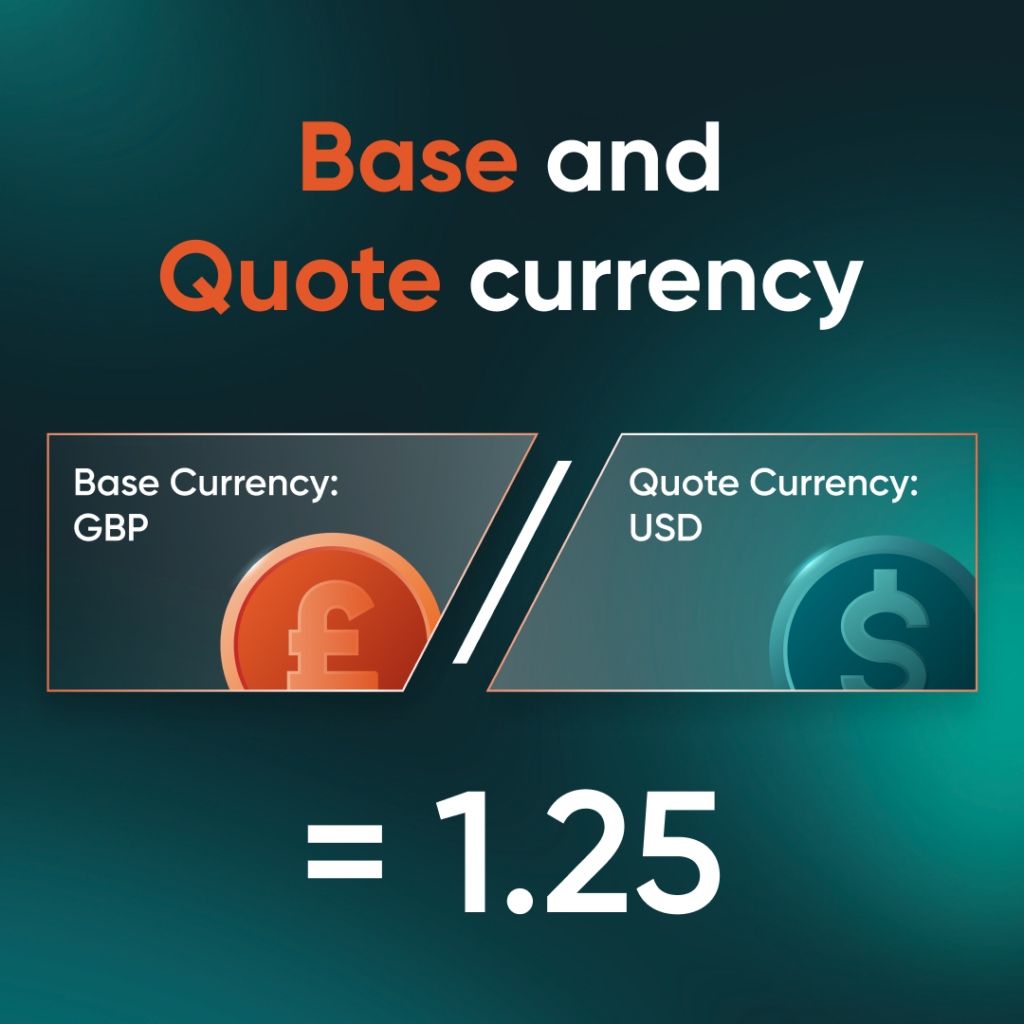
- Base currency: the currency listed first.
- Quote currency: the currency listed second.
- Exchange rate: how much of the quote currency is needed to buy one unit of the base currency.
Consider this example:
| Currency pair | Base currency | Quote currency | Example meaning |
|---|---|---|---|
| EUR/USD | EUR | USD | €1 = US$1.10 |
| GBP/USD | GBP | USD | £1 = a stated amount of USD |
| USD/JPY | USD | JPY | US$1 = a stated amount of JPY |
| NZD/USD | NZD | USD | NZ$1 = a stated amount of USD |
So, if NZD/USD = 0.6000, one New Zealand dollar is worth 0.60 US dollars at that quoted rate.
The key point is that Forex always involves a relationship between currencies. You’re not simply buying “the euro” in isolation. You’re taking a position on the value of the euro relative to another currency.
How does a Forex currency pair work?
The order of the currencies matters.
Suppose EUR/USD is trading at 1.1000.
If you buy EUR/USD, you are buying euros and selling US dollars. You’re generally expecting the euro to strengthen relative to the US dollar.
If you sell EUR/USD, you’re selling euros and buying US dollars. You’re generally expecting the euro to weaken relative to the US dollar.
This is why beginners sometimes find Forex terminology confusing. A buy or sell order applies to the pair, not just to one currency.
A simple example
Imagine EUR/USD moves from:
1.1000 → 1.1050
The euro has risen relative to the US dollar. One euro now buys more dollars than it did at 1.1000.
If, instead, EUR/USD falls from 1.1000 to 1.0950, the euro has weakened relative to the dollar.
The same principle applies to NZD/USD, GBP/USD, USD/JPY and other pairs.
⇒ You can also see how the New Zealand dollar is tracked through RBNZ exchange rates and the Trade Weighted Index.
Base currency vs quote currency
One of the most useful habits for a new trader is to identify the two currencies before thinking about whether a price is going up or down.
For GBP/USD:
- GBP is the base currency.
- USD is the quote currency.
- The exchange rate tells you how many US dollars are required to buy one pound.
For USD/JPY:
- USD is the base currency.
- JPY is the quote currency.
- The exchange rate tells you how many Japanese yen are required to buy one US dollar.
This also explains why the same currency can appear to be moving in opposite directions depending on the pair.
For example, EUR/USD rising means the euro is strengthening against the dollar. But USD/EUR rising would describe the opposite relationship.
What are the main types of currency pairs?
Forex pairs are commonly grouped into major, minor and exotic pairs. Exact classifications can vary between market participants and providers.
⇒ For broader context on the size of the global Forex market, see the BIS Triennial Central Bank Survey.
Major currency pairs
Major pairs generally involve the US dollar and another highly traded currency.
Common examples include:
- EUR/USD
- GBP/USD
- USD/JPY
- USD/CHF
- AUD/USD
- USD/CAD
- NZD/USD
These pairs are widely followed and tend to have deep liquidity, although liquidity and trading costs can vary with market conditions and the provider.
Minor currency pairs
Minor pairs, sometimes called cross pairs, don’t include the US dollar.
Examples include:
- EUR/GBP
- EUR/JPY
- GBP/JPY
- AUD/NZD
A cross can be useful when the trader wants exposure to the relative value of two currencies without directly trading a USD pair.
Exotic currency pairs
Exotic pairs generally combine a major currency with a currency from a smaller or emerging market.
Examples can include combinations involving the Mexican peso, Turkish lira or South African rand.
These pairs can behave differently from heavily traded major pairs. Spreads and liquidity may also differ, so beginners shouldn’t assume that every currency pair has the same trading characteristics.
What does a currency pair price actually tell you?
A currency-pair price is an exchange rate, not a forecast.
Suppose NZD/USD is quoted at:
0.5800
This means NZ$1 is worth US$0.58 at that quoted rate.
If the quote rises to 0.5900, the New Zealand dollar has strengthened relative to the US dollar.
If it falls to 0.5700, the New Zealand dollar has weakened relative to the US dollar.
For New Zealand readers, this relationship can be useful beyond trading. The Reserve Bank of New Zealand publishes exchange-rate data showing the NZ dollar against several major international currencies and also tracks the NZD through its Trade Weighted Index.
What are pips in a currency pair?
A pip is a standardised unit commonly used to describe small movements in a currency pair.
For many major currency pairs, one pip is 0.0001. For example:
EUR/USD: 1.1000 → 1.1010 = 10 pips
Pairs involving the Japanese yen are commonly quoted to fewer decimal places, so their conventional pip size is different.
Pip movements help traders describe price changes without constantly referring to long decimal numbers.
However, a pip does not automatically equal a fixed dollar amount. The monetary value of a pip depends on factors such as position size, the currency pair and the account currency.
A simple currency-pair calculation
Suppose a trader has a hypothetical 10,000 EUR position in EUR/USD.
The exchange rate moves from:
1.1000 → 1.1050
The change is:
1.1050 − 1.1000 = 0.0050
For a 10,000 EUR position:
10,000 × 0.0050 = US$50
So the gross change in the position’s value would be approximately US$50, before considering the spread, commission, financing costs or other charges.
This is an illustration of price movement, not a prediction of profit. Actual trading results depend on the product, position size, execution price, costs and other factors.
Why does the currency pair matter?
Choosing a pair isn’t just choosing a symbol on a trading platform. Different pairs can have different characteristics.
A trader may consider:
- Liquidity: How actively the pair is traded.
- Spread: The difference between the bid and ask price.
- Volatility: How much and how quickly the exchange rate tends to move.
- Economic exposure: Which economies and currencies influence the pair.
- Trading costs: Spreads, commissions and possible overnight financing.
- Market conditions: Liquidity and volatility can change over time.
For example, NZD/USD can be relevant to New Zealand-focused traders because it directly expresses the NZ dollar’s value against the US dollar. But that doesn’t make it automatically easier or safer to trade.
Common beginner mistakes
Thinking you’re trading only one currency
Buying EUR/USD means buying euros and simultaneously taking the opposite side in US dollars. The pair is one relationship.
Assuming a rising quote is always “good”
A rising pair isn’t inherently good or bad. It depends on whether you’re long or short and where you entered.
Confusing the quote with the amount you will make
If EUR/USD moves by 20 pips, that doesn’t tell you your profit or loss by itself. Position size and other trading details matter.
Treating every pair as equally liquid
Major pairs and less-traded pairs can have different spreads, liquidity and execution characteristics.
Ignoring leverage
Many retail Forex products use leverage. Leverage allows a trader to control a larger exposure with less initial capital, but it also magnifies losses. The Financial Markets Authority warns that derivatives trading is high risk and that losses or gains can be many multiples of the initial amount required.
Currency pairs and Forex trading in New Zealand
The basic meaning of a currency pair is the same in New Zealand as elsewhere.
⇒ New Zealand readers considering leveraged Forex products should check the FMA’s guidance on derivatives and their risks before trading.
The regulatory framework can be different, however. In New Zealand, the FMA says that firms making regulated offers of derivatives to retail investors must be licensed as derivatives issuers. The FMA’s definition of derivatives includes products such as CFDs, margin contracts and rolling spot contracts.
That doesn’t mean every way of exchanging currencies is automatically a derivative. The regulatory treatment depends on the product and how it is structured.
If you’re a New Zealand resident considering a leveraged retail Forex product, check the provider’s current regulatory status rather than assuming that a company is regulated simply because it accepts New Zealand customers. The FMA maintains a public list of licensed providers.
⇒ Before choosing a provider, New Zealand traders can check the FMA’s information on licensed derivatives issuers.
This is general educational information, not personal financial, legal or tax advice. Rules can differ between countries and individual circumstances.
Why currency pairs are the foundation of Forex
The global foreign exchange market is built around exchanging one currency for another. The Bank for International Settlements’ 2022 Triennial Central Bank Survey recorded average global FX turnover of about US$7.5 trillion per day in April 2022, illustrating the enormous scale of the market.
For a beginner, though, the important lesson isn’t the market’s size. It’s understanding the relationship represented by the quote.
When you see NZD/USD, think:
“How many US dollars is one New Zealand dollar worth?”
When you see USD/JPY, think:
“How many Japanese yen is one US dollar worth?”
Once that becomes automatic, reading Forex prices becomes much less intimidating.
Final takeaway
A currency pair is the quoted relationship between two currencies. The first currency is the base currency and the second is the quote currency. The price tells you how much of the quote currency is needed for one unit of the base currency.
For beginners, focus on understanding the pair before worrying about complex strategies. Learn what a quote means, how buying and selling affect the two currencies, how pips describe price movements, and how position size and leverage affect risk.
If you’re building your Forex knowledge from the ground up, the next useful step is understanding how Forex trading actually works, including orders, spreads and positions.
Financial-risk note: Forex and leveraged derivatives can result in substantial losses. This article is for general education and does not constitute personalised financial advice.
Once you understand currency pairs, the next step is learning how Forex trading works and how prices, orders and positions fit together.
KEY TAKEAWAYS
- A Forex currency pair always contains two currencies.
- The first currency is the base currency; the second is the quote currency.
- EUR/USD at 1.1000 means €1 is worth US$1.10 at that quoted rate.
- Major, minor and exotic pairs can have different liquidity, spreads and volatility.
- A pip measures a small price movement, but its monetary value depends on position size and other factors.
- Leverage can magnify both gains and losses.
- New Zealand traders should verify the current regulatory status of any retail leveraged-derivatives provider with the FMA.
FAQ’s
What is a Forex currency pair?
A Forex currency pair compares the value of one currency with another. The first is the base currency and the second is the quote currency. EUR/USD, for example, compares the euro with the US dollar.
What does EUR/USD mean?
EUR/USD tells you how many US dollars are required to buy one euro. If the quote is 1.1000, one euro is worth 1.10 US dollars at that quoted rate.
What happens when you buy a currency pair?
When you buy a pair, you’re buying the base currency while selling the quote currency. A trader buying EUR/USD is therefore taking a position that benefits if EUR/USD rises, before considering costs and other factors.
What is the difference between a major and minor currency pair?
Major pairs generally include the US dollar and another major currency. Minor pairs, or crosses, don’t include the US dollar. Examples of crosses include EUR/GBP and AUD/NZD.
Is NZD/USD a major currency pair?
NZD/USD is commonly grouped among the major currency pairs because it pairs the New Zealand dollar with the US dollar. Classification terminology can vary between market participants.
Does a higher currency-pair price mean I make money?
Not necessarily. It depends on whether you bought or sold the pair, your entry price, position size, transaction costs and other factors.
Are currency pairs risky to trade?
Yes. Currency prices can move against a trader, and leveraged Forex products can magnify losses. The FMA describes derivatives trading as very high risk.
Do all currency pairs have the same pip value?
No. Pip value depends on the currency pair, position size, account currency and broker conventions. Japanese-yen pairs also use a different conventional pip decimal position from many other major pairs.