
If you’re new to Forex, you’ve probably seen names such as EUR/USD, GBP/USD and USD/JPY and wondered why some currency pairs are called major forex pairs.
In simple terms, major pairs are the currency pairs most commonly associated with the world’s largest and most actively traded currencies. In everyday Forex terminology, the seven commonly recognised major pairs all include the US dollar: EUR/USD, USD/JPY, GBP/USD, USD/CHF, AUD/USD, USD/CAD and NZD/USD.
They matter because trading activity, liquidity, spreads and the economic news affecting these currencies can make the major pairs particularly important to understand when learning Forex. The US dollar was on one side of 89% of all FX trades in the BIS 2025 survey, illustrating its central role in the global market. hat are major forex pairs?
Major forex pairs are the currency pairs generally regarded by the Forex market as the principal, most actively traded pairs involving the US dollar.
The commonly recognised seven are:
| Major pair | Currencies | Simple description |
|---|---|---|
| EUR/USD | Euro / US dollar | Euro priced in US dollars |
| USD/JPY | US dollar / Japanese yen | US dollar priced in yen |
| GBP/USD | British pound / US dollar | Pound priced in US dollars |
| USD/CHF | US dollar / Swiss franc | US dollar priced in Swiss francs |
| AUD/USD | Australian dollar / US dollar | Australian dollar priced in US dollars |
| USD/CAD | US dollar / Canadian dollar | US dollar priced in Canadian dollars |
| NZD/USD | New Zealand dollar / US dollar | New Zealand dollar priced in US dollars |
The term “major” is a market convention rather than a single official classification imposed by one global regulator. You’ll sometimes see lists or terminology vary slightly between educational sources.
The important point for a beginner is that these seven pairs are the conventional core group.
QUICK ANSWER
What are major forex pairs?
Major forex pairs are the seven currency pairs commonly recognised as the core major markets in retail and institutional Forex:
- EUR/USD
- USD/JPY
- GBP/USD
- USD/CHF
- AUD/USD
- USD/CAD
- NZD/USD
They all include the US dollar and involve highly traded currencies. They are widely followed because of their substantial market activity and liquidity, but major does not mean safe or guaranteed to be profitable.
Why are these pairs called major?
There are two useful ways to think about the word major.
⇒ Source: The BIS survey provides detailed data on currency participation and trading activity through the BIS Data Portal.
First, the currencies involved are among the world’s most actively traded currencies. The BIS’s 2025 Triennial Central Bank Survey found that the US dollar accounted for 89% of FX transactions by currency share, followed by the euro at 28.9%, the Japanese yen at 16.8% and sterling at 10.2%.
Second, these pairs tend to have substantial trading activity and deep markets. That doesn’t mean they are automatically safer or more profitable. It simply means there is a large amount of market participation around them.
The global FX market recorded approximately US$9.6 trillion in average daily turnover in April 2025, according to the BIS. r a beginner, this distinction matters. High trading activity is not the same thing as low risk.
⇒ Source: The global foreign exchange market reached approximately US$9.6 trillion in average daily turnover in April 2025, according to the BIS 2025 Triennial Central Bank Survey.
The seven major forex pairs explained
1. EUR/USD
EUR/USD compares the euro with the US dollar.
If EUR/USD is quoted at 1.1000, the basic interpretation is that one euro is worth 1.1000 US dollars.
This is one of the most widely followed currency pairs and is often the first major pair beginners encounter.
The pair can be influenced by economic and monetary developments in both the euro area and the United States, including interest-rate expectations, inflation, employment data and central-bank decisions.
2. USD/JPY
USD/JPY compares the US dollar with the Japanese yen.
A quote of 150.00 means approximately 150 Japanese yen for one US dollar.
One beginner trap is assuming that every currency pair behaves or is quoted in the same way. USD/JPY uses the yen as the quote currency, so changes in the exchange rate need to be interpreted accordingly.
3. GBP/USD
GBP/USD compares the British pound with the US dollar and is sometimes called “cable.”
For example, a GBP/USD quote of 1.2800 means one pound is worth 1.2800 US dollars.
Because the United Kingdom and United States have different economies and monetary-policy expectations, economic announcements from either country can affect the pair.
4. USD/CHF
USD/CHF compares the US dollar with the Swiss franc.
The Swiss franc is an important international currency, while Switzerland has a significant financial sector. As with the other major pairs, movements can reflect changing expectations about interest rates, economic conditions and broader market sentiment.
5. AUD/USD
AUD/USD compares the Australian dollar with the US dollar.
It is particularly relevant to traders watching Australia, the United States and developments that can affect Australia’s economy and exports.
For New Zealand readers, AUD/USD is also worth knowing because Australia is an important regional economy and trading partner. It is still a global currency pair rather than a New Zealand-specific market.
6. USD/CAD
USD/CAD compares the US dollar with the Canadian dollar.
Canada’s economy has important links to commodities, particularly energy, so commodity-market developments can sometimes be relevant when analysing the Canadian dollar.
That doesn’t mean oil prices mechanically determine USD/CAD. Currency prices reflect many factors at once.
7. NZD/USD
NZD/USD compares the New Zealand dollar with the US dollar.
For New Zealand readers, this is the major pair that will probably feel most familiar. A quote of 0.6000 means one New Zealand dollar is worth 0.6000 US dollars.
The Reserve Bank of New Zealand publishes NZD exchange-rate data against several major international currencies and maintains a trade-weighted index measuring the NZD against currencies of New Zealand’s major trading partners.
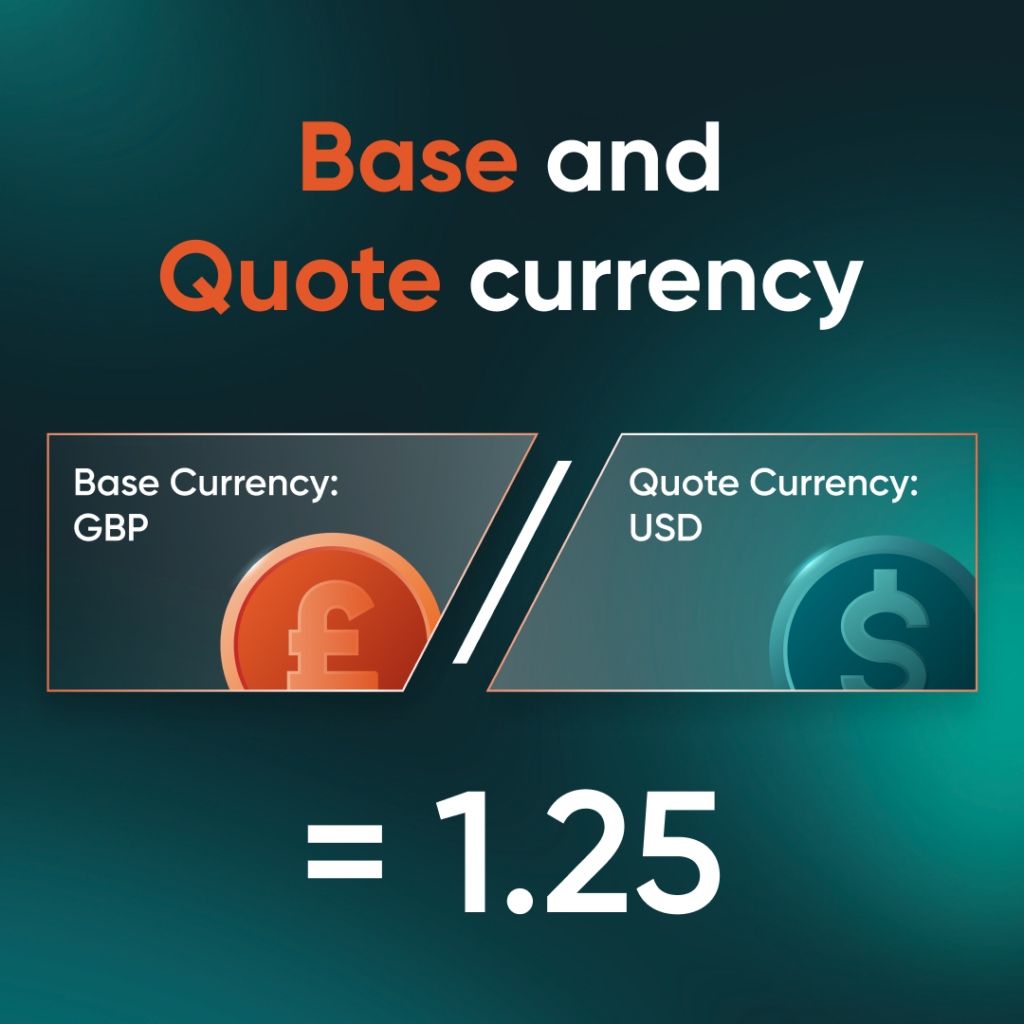
How to read a major currency pair
A currency pair always contains two currencies.
The first is the base currency.
The second is the quote currency.
For EUR/USD:
EUR = base currency
USD = quote currency
If EUR/USD rises from 1.1000 to 1.1100, one euro now buys more US dollars than before.
If it falls from 1.1000 to 1.0900, one euro buys fewer US dollars.
This is why the direction of a pair matters. You’re not simply asking whether the euro or dollar is “going up.” You’re asking whether the value of the euro is rising or falling relative to the dollar.
 Before comparing major pairs, it helps to understand what a currency pair is and how the base and quote currencies work.
Major vs minor vs exotic currency pairs
Major pairs aren’t the only currencies you can trade.
A useful beginner classification is:
| Type | Example | General idea |
|---|---|---|
| Major | EUR/USD | Commonly traded pair involving USD |
| Minor/cross | EUR/GBP | Major currencies paired without USD |
| Exotic | USD/TRY | USD paired with a less frequently traded currency |
A minor pair, often called a cross, doesn’t contain the US dollar. Examples include EUR/GBP, EUR/JPY and GBP/CHF.
An exotic pair generally combines a major currency with a less frequently traded currency, such as USD/TRY.
These categories are useful shorthand, but they shouldn’t be treated as precise measures of risk. A major pair can experience sharp movements, while a minor or exotic pair can have different liquidity and transaction-cost characteristics.
Why liquidity matters to beginners
Liquidity describes how easily a market can absorb buying and selling activity without causing large price changes.
Major pairs generally have substantial trading activity. That can be relevant to transaction costs because market liquidity is one factor that influences bid-ask spreads.
But don’t make the common mistake of translating “major” into “safe.”
A major pair can move quickly after important economic news. If you’re trading with leverage, a relatively small percentage move in the exchange rate can have a much larger effect on the capital committed to a leveraged position.
The BIS survey also shows that FX activity is enormous, but market size itself doesn’t remove trading risk. simple example: choosing between two pairs
Imagine a beginner is learning how economic announcements affect currency markets.
They could start by studying EUR/USD and focus on:
- US economic releases
- European economic releases
- Federal Reserve decisions
- European Central Bank decisions
- How the exchange rate reacts to changing interest-rate expectations
- The spread and trading costs offered by their broker
This doesn’t make EUR/USD a guaranteed “better” pair to trade. It simply gives the learner a liquid, widely followed market with plenty of publicly available economic information to study.
A better beginner question is therefore not:
“Which major pair will make me the most money?”
It’s:
“Which pair can I understand well enough to manage its risks?”
Common mistakes beginners make
Assuming all major pairs move together
They don’t. Each pair represents a relationship between two currencies, so the economic forces affecting each side matter.
Thinking major means low risk
Major pairs can still be volatile. Leverage can magnify both gains and losses.
Ignoring the quote direction
USD/JPY and EUR/USD aren’t read in exactly the same way. Always identify the base and quote currencies first.
Choosing a pair only because it’s popular
Popularity isn’t a trading strategy. A pair should be understood in terms of its market, costs, volatility and the economic factors influencing it.
Forgetting trading costs
The exchange-rate movement isn’t the only consideration. Spreads, commissions, financing costs and other broker-specific charges can affect the result of a trade.
Trading costs matter too, so beginners should understand what a Forex spread is before comparing currency pairs.
Which major forex pair should a beginner study first?
There’s no universally correct first pair.
A sensible educational approach is to choose one or two pairs rather than trying to follow all seven at once.
For example:
- Learn how EUR/USD is quoted.
- Follow the major economic events affecting the euro and US dollar.
- Watch how the pair reacts to news.
- Learn how spreads and pips work.
- Practise reading charts without risking real money.
- Only then consider whether live trading is appropriate for you.
If you’re in New Zealand, NZD/USD can be especially useful to study because it directly involves the New Zealand dollar. But being familiar with a currency doesn’t automatically make a pair suitable for your personal trading circumstances.
What about Forex trading in New Zealand?
The terminology of major currency pairs is broadly the same globally, including in New Zealand.
The regulatory environment is different, however. The New Zealand Financial Markets Authority (FMA) says that certain products, including contracts for difference and rolling spot contracts, fall within the derivatives framework. A derivatives issuer making a regulated offer of derivatives must generally be licensed by the FMA, subject to the applicable legal framework and exemptions.
If you’re still learning the basics, how Forex trading works provides useful context before moving on to individual currency pairs.
The FMA also warns that derivatives are complex financial products and that retail customers can experience losses beyond what they expected.
So if you’re a New Zealand resident considering leveraged Forex products, check the provider’s current regulatory status rather than assuming that a company is regulated simply because it accepts New Zealand customers.
This article is educational information, not personal financial, legal or tax advice. Rules and individual circumstances can differ by jurisdiction.
⇒ Source: New Zealand readers can refer to the RBNZ foreign exchange turnover statistics for information about activity in the local FX market.
⇒ Source: The RBNZ exchange rates and Trade Weighted Index provide official information on the New Zealand dollar and its exchange-rate measures.
The practical way to think about major pairs
You don’t need to memorise dozens of currency symbols to start learning Forex.
Remember the seven conventional major pairs:
EUR/USD, USD/JPY, GBP/USD, USD/CHF, AUD/USD, USD/CAD and NZD/USD.
Then learn what each quote actually means.
From there, the next useful concepts are pips, spreads, market hours, position size and risk management. Understanding those mechanics is more valuable than simply memorising a list of pairs.
Once you understand how major pairs are quoted, learning about Forex pips will help you measure their price movements.
Risk reminder
Forex and leveraged derivatives trading involve significant risk. Leverage can increase the size of both potential gains and losses, and you can lose money. The examples in this article are educational illustrations, not trading recommendations or predictions.
KEY TAKEAWAYS
- The seven conventional major pairs all include the US dollar.
- EUR/USD, USD/JPY and GBP/USD are among the most widely followed FX pairs.
- NZD/USD is the major pair directly involving the New Zealand dollar.
- Major, minor and exotic are market classifications, not guarantees of risk level.
- Liquidity can affect trading conditions, including spreads, but doesn’t eliminate volatility.
- Beginners should learn how a pair is quoted before analysing its price movements.
- Understanding risk, leverage, spreads and position size is more important than simply choosing a popular pair.
Knowing Forex market hours can also help you understand when different currency markets are most active.
FAQ’s
What is the most traded major forex pair?
EUR/USD is generally regarded as the most actively traded individual currency pair, although the BIS’s currency-level statistics are the more authoritative way to assess overall currency participation. The US dollar was on one side of 89% of all FX transactions in the 2025 BIS survey.
How many major forex pairs are there?
The conventional retail-Forex classification identifies seven major pairs: EUR/USD, USD/JPY, GBP/USD, USD/CHF, AUD/USD, USD/CAD and NZD/USD.
Is NZD/USD a major forex pair?
Yes. NZD/USD is conventionally included among the seven major Forex pairs. It represents the New Zealand dollar against the US dollar.
Are major forex pairs safer?
Not necessarily. Major pairs generally have high levels of trading activity, but their prices can move sharply. Leverage can also magnify losses.
What is the difference between major and minor forex pairs?
Major pairs generally include the US dollar. Minor pairs, or crosses, contain major currencies but exclude the US dollar. EUR/GBP is an example of a minor or cross pair.
Are major forex pairs good for beginners?
They can be useful markets to study because they are widely followed and have substantial publicly available market information. However, no currency pair is automatically appropriate for every beginner or trader.
Do major forex pairs have lower spreads?
Major pairs often have competitive spreads because of their substantial trading activity, but the actual spread depends on the pair, market conditions, broker, account type and execution arrangement. Always check current trading costs rather than assuming a particular spread.